

Running Physical Therapy: Why 50% of Runners Get Hurt Every Year and How the Right PT Fixes It for Good
You trained hard, ran smart, and still ended up sidelined. That nagging knee, that shin that won't quit, that IT band screaming at mile 3. You're not alone, and it's not your fault. But the fix isn't rest. It's targeted, runner-specific physical therapy that treats the root cause, not just the pain.
Running physical therapy isn't your standard PT clinic with a laminated exercise sheet and a 15-minute session. It's a specialized branch of sports medicine focused entirely on how your body moves at speed, where your mechanics break down, and why the same injury keeps coming back no matter how many times you ice it. A running-focused physical therapist watches you run, analyzes your gait frame by frame, identifies muscular imbalances, and builds a plan around your specific body, not a generic protocol ripped from a textbook.
The Runner's Mechanic in Asheville, NC is one of the few clinics in the country built exclusively for runners. Led by Miriam Salloum, MPT — an orthopedic clinical specialist with 25+ years treating runners, a Mayo Clinic internship, and experience at an Olympic Training Site — every session starts with a full biomechanical evaluation, video gait analysis, and a plan designed for your body. Book your runner's evaluation today.
The thing is, most runners don't go to PT until something is already broken. And when they do, they end up at a general orthopedic clinic where the therapist splits time between post-surgical knee replacements and your running injury. That's not a knock on general PT. But running biomechanics are a specialty. The forces are different. The patterns are different. The treatment has to be different.
Why Runners Keep Getting Hurt (The Real Numbers)
Running injuries aren't freak accidents. They're predictable patterns that show up when training load outpaces the body's ability to adapt, when biomechanical faults go unaddressed, or when runners push through pain signals their body is sending for a reason. The data is staggering, and it tells a story that every runner should understand before the next injury hits.
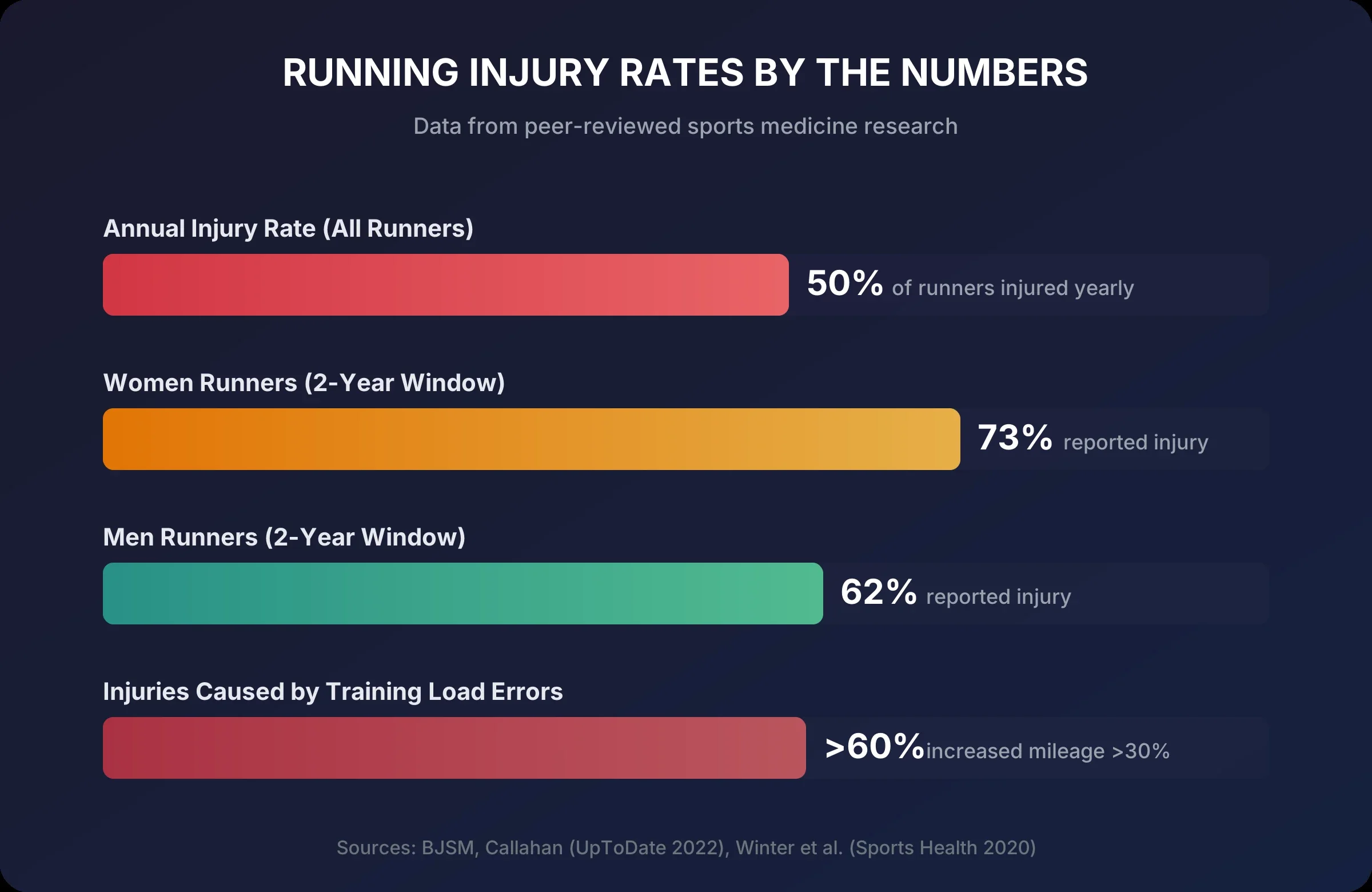
"Approximately 50% of regular runners sustain an injury each year, with the knee, lower leg, and foot accounting for the majority of running-related injuries." — British Journal of Sports Medicine, Running Injury Epidemiology Review
That's not a typo. Half of all runners get hurt every single year. A 2022 analysis published in UpToDate found that 73% of women runners and 62% of men runners reported at least one injury over a two-year tracking period. And a 2020 study in Sports Health followed 76 recreational runners for 12 months — 51% reported a running-related injury during that window.
Training Errors: The Number One Cause
Over 60% of injured male runners in a prospective study had increased their weekly distance by more than 30% in the four weeks leading up to their injury. That "10% rule" coaches repeat isn't just a suggestion — it's backed by real injury data. But here's what most runners miss: training errors don't just mean too much mileage. They mean too much intensity, too little recovery, too rapid a shift in surface or terrain, or adding speedwork before the body has adapted to base volume.
The other major contributors are biomechanical factors — things like excessive hip drop during stance phase, overstriding, or a crossover gait pattern that loads the IT band with every single step. These aren't things you can see yourself. They require a trained eye and, ideally, video gait analysis at clinical-grade frame rates.
Why Rest Alone Doesn't Fix Running Injuries
Most runners treat injuries by stopping. They rest for two weeks, three weeks, six weeks. The pain goes away. They lace up, run three miles, and by mile 2 it's back. That's because rest removes the symptom without addressing the mechanical or muscular fault that caused it. Running physical therapy identifies that fault — a weak glute medius, a stiff ankle, a thoracic spine that doesn't rotate — and corrects it so the injury doesn't keep cycling back.
What Running Physical Therapy Actually Looks Like
If you've never been to a running-specific physical therapist, the experience is completely different from a standard PT clinic. There's no waiting room full of patients cycling through three machines. A proper running PT session is one-on-one, hands-on, and focused entirely on how your body functions during the act of running.
The Initial Biomechanical Evaluation
A thorough running PT evaluation takes 90 minutes to two hours. At clinics like The Runner's Mechanic in Asheville, the initial assessment includes a structural alignment evaluation, functional movement screening, video gait analysis on a treadmill, and a full injury history review. The therapist isn't just looking at the painful area. They're checking ankle dorsiflexion range, hip internal rotation, single-leg balance, core anti-rotation strength, and dozens of other variables that contribute to injury.
This approach mirrors protocols from the UVA Speed Clinic and Harvard Spaulding National Running Center — two of the most respected running medicine programs in the country. The point is to build a complete biomechanical profile so treatment targets the cause, not the symptom.
Hands-On Treatment Techniques
Running physical therapists use a mix of manual therapy and specialized techniques depending on the injury. Common treatments include intramuscular dry needling (IMT) for trigger points and muscle tightness, instrument-assisted soft tissue mobilization (IASTM) for fascial restrictions, VacuTherapies medical cupping for blood flow and recovery, and kinesio taping for neuromuscular support during training.
The manual work is only half the equation. The other half is corrective exercise — targeted drills that address the specific weakness or mobility deficit causing your injury. A runner with a weak glute medius gets a different program than a runner with poor ankle mobility. It's not a template. It's built for you.
Real-Time Gait Retraining
This is where running PT separates itself from every other form of treatment. Real-time gait retraining uses live video feedback while you run on a treadmill. Your therapist cues changes — increase cadence, reduce overstriding, improve hip extension — and you see the difference in real time on screen. A 2024 study of 390 novice runners found that just two weeks of instrumented treadmill gait retraining produced significantly lower vertical loading rates and reduced running injury incidence over the following 12 months.
"Two weeks of gait retraining on an instrumented treadmill led to significantly lower running injury incidence over a 12-month follow-up period in a cohort of 390 novice runners." — Randomized Controlled Trial, 2024 (Novice Runner Injury Prevention)
The 7 Most Common Running Injuries PT Treats
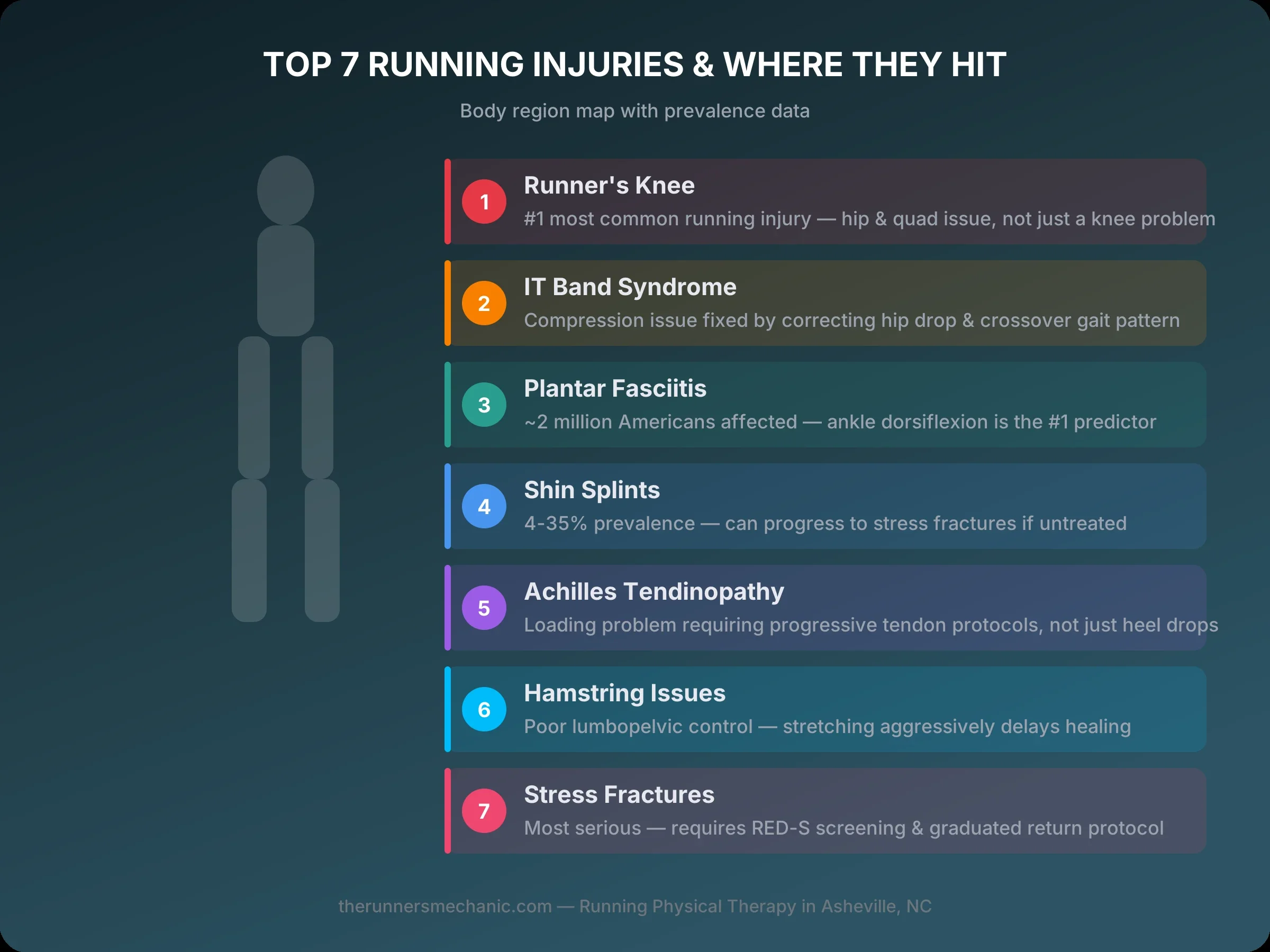
Not every ache is the same, and not every running injury responds to the same treatment. Here are the seven injuries that bring runners into PT clinics more than any others, and what a running-specific physical therapist does differently for each one.
1. Runner's Knee (Patellofemoral Pain Syndrome)
That dull ache behind or around your kneecap, especially going downhill or sitting for long periods. Runner's knee is the single most common running injury, and it's almost always a hip and quad problem masquerading as a knee problem. A running PT evaluates your patellofemoral tracking, assesses quad-to-hamstring strength ratios, checks hip stability, and builds a progressive loading program that takes pressure off the joint. Generic advice to "strengthen your quads" misses the point — it's about which part of the quad, at what angle, with what hip position.
2. IT Band Syndrome
Sharp pain on the outside of the knee that hits at the same distance every run. IT band syndrome is a compression issue, not a friction problem (the old "friction syndrome" model has been updated). Running PT addresses the crossover gait pattern and hip drop that loads the IT band, uses manual techniques to reduce tissue sensitivity, and modifies running form to distribute forces more evenly. Foam rolling the IT band itself does almost nothing — the treatment is upstream at the hip.
3. Plantar Fasciitis
Stabbing heel pain with your first steps in the morning. Plantar fasciitis affects roughly 2 million Americans and is one of the most stubborn running injuries to resolve without targeted treatment. Running PT includes calf and intrinsic foot strengthening, load management strategies, taping techniques for short-term relief, and gait modifications that reduce plantar fascia strain. A specialist also screens for contributing factors like limited ankle dorsiflexion — the single strongest predictor of plantar fasciitis in runners.
4. Shin Splints (Medial Tibial Stress Syndrome)
Pain along the inner border of the shinbone that worsens during and after running. Rates range from 4% to 35% depending on the population studied, with new runners and military recruits at the highest risk. Left untreated, shin splints can progress to tibial stress fractures. Running PT differentiates between bone stress and muscular overload, modifies training volume, and addresses the two most common contributing factors: excessive pronation and calf weakness.
5. Achilles Tendinopathy
Pain and stiffness in the Achilles tendon, usually 2-6 cm above the heel insertion. Achilles tendinopathy is a loading problem — the tendon is being asked to handle more force than it can tolerate. Running PT uses a progressive tendon-loading protocol (heavy slow resistance and isometrics) combined with calf strengthening and running volume adjustments. The old "eccentric heel drops only" approach has been replaced by more nuanced loading programs based on current tendon research.
6. Hamstring Strains and Proximal Hamstring Tendinopathy
Sharp pain during speed work (acute strain) or deep buttock pain during hills and tempo runs (proximal tendinopathy). Hamstring problems in runners are almost always related to poor lumbopelvic control and insufficient hip extension strength. A running PT tests hamstring and glute strength ratios, evaluates pelvic positioning during running, and builds a progressive return-to-speed program. Stretching a strained hamstring aggressively is one of the most common mistakes runners make — it actually delays healing.
7. Stress Fractures
Localized bone pain that gets worse with impact and better with rest. Stress fractures are the most serious common running injury and require immediate activity modification. Running PT manages the non-running period with cross-training protocols, addresses bone loading risk factors (cadence, impact force, nutritional status), and builds a graduated return-to-running program that reintroduces impact systematically. The PT also screens for relative energy deficiency in sport (RED-S), which significantly increases fracture risk, especially in female runners.
How Gait Analysis Changes Everything
You can't fix what you can't see. And the human eye, no matter how experienced, misses details that happen in milliseconds during a running stride. That's why clinical-grade running gait analysis has become the gold standard in running physical therapy.
What Happens During a Gait Analysis
A proper gait analysis involves recording you running on a treadmill at multiple speeds from multiple camera angles — usually posterior, lateral, and anterior views. The video is then broken down frame by frame to evaluate cadence, foot strike pattern, stride length, vertical oscillation, hip adduction angle, pelvic drop, trunk lean, arm swing, and ground contact time. Some clinics also use pressure plates or wearable sensors for additional force data.
At The Runner's Mechanic, gait analysis is built into every runner's biomechanical evaluation. The approach is modeled after protocols used at the UVA Speed Clinic and the Harvard Spaulding National Running Center — institutions that have published some of the most significant research on gait retraining in the past decade.
The Gait Faults That Cause 80% of Running Injuries
While every runner's mechanics are unique, research has identified several gait patterns that consistently correlate with injury. Overstriding (landing with the foot well ahead of the center of mass) dramatically increases braking forces and vertical loading rate. Excessive hip adduction (the knee collapsing inward during stance) is linked to runner's knee, IT band syndrome, and tibial stress injuries. A low cadence below 160 steps per minute at easy pace often accompanies both of these faults.
Crossover gait — where the feet land on or across the midline — loads the IT band and increases lateral ankle instability. Excessive forward trunk lean shifts load to the knees and quads. And insufficient hip extension at toe-off forces the hamstrings and hip flexors to compensate in ways that create chronic overuse patterns.
Can You Actually Change How You Run?
Yes. And the research backs it up. Gait retraining using real-time visual or auditory feedback has been shown to produce lasting changes in running mechanics that persist months after the training period ends. The key is specificity — changing one or two variables at a time, using measurable external cues (a metronome for cadence, a mirror line for crossover), and practicing at the correct intensity. Trying to overhaul your entire running form at once is a recipe for frustration and, ironically, new injuries.
Why Strength Training Is Non-Negotiable for Runners
The biggest gap in most runners' training isn't their mileage. It's their strength work. Or more accurately, their total lack of it. Strength training for runners is the single most effective injury prevention strategy backed by sports medicine research, and it's the first thing a running physical therapist prescribes regardless of the presenting injury.
The Muscles That Matter Most
Running is a single-leg sport. At any given point in the gait cycle, one leg is absorbing 2.5 to 3 times your body weight. That means single-leg strength, stability, and power are far more important than bilateral movements like back squats. The muscles that matter most for runners are the glute medius and maximus (hip stability and propulsion), the calf complex — both gastrocnemius and soleus (push-off power and Achilles health), the deep hip rotators (pelvic control), and the core anti-rotation muscles (trunk stability over a mobile pelvis).
A running PT tests these muscles individually and builds a program that targets your specific deficits. A runner with IT band syndrome and a weak glute medius gets a different program than a runner with Achilles tendinopathy and a weak soleus. The exercises are the same general category — single-leg squats, step-ups, calf raises, hip hikes — but the progressions, sets, reps, and loading strategies are completely individualized.
How to Structure Strength Work Around Running
The number one reason runners skip strength training is that they don't know how to fit it around their run schedule without trashing their legs. A good running PT program addresses this directly. Heavy strength work (80%+ 1RM, 3-5 reps) goes on hard running days so easy days stay easy. Light activation and mobility work is fine before runs. And the total volume is kept manageable — two to three sessions per week, 30 to 40 minutes each, targeting running-specific patterns.
The goal isn't to look like a powerlifter. It's to build enough structural resilience that your body can handle the repetitive impact of running without breaking down. That's a very different training stimulus than bodybuilding, and it requires a very different program design.
How to Pick the Right Running PT (Red Flags and Green Flags)
Not all physical therapists are created equal when it comes to running injuries. A PT who specializes in post-operative ACL rehab is excellent at what they do — but they're not necessarily the right person to evaluate your running gait and build a return-to-running program after a stress reaction. Here's how to tell the difference.
Green Flags: What to Look For
The PT runs themselves (or has extensive experience treating runners specifically). They have advanced certifications like OCS (Orthopedic Clinical Specialist), SCS (Sports Clinical Specialist), or COMT (Certified Orthopedic Manual Therapist). They perform video gait analysis as part of their evaluation. They ask about your training history, race goals, and running volume. They give you a specific return-to-running timeline with milestones. And they treat you one-on-one for the full session, not in a mill where you share your therapist with three other patients.
Miriam Salloum at The Runner's Mechanic holds both OCS and COMT certifications, has over 25 years of clinical experience with runners, completed a fellowship at the Mayo Clinic, and worked as a physical therapist at an Olympic Training Site. That's the caliber of specialization you want for a running-specific injury.
Red Flags: What to Avoid
The PT doesn't watch you run during the evaluation. They give you a printed sheet of generic exercises on day one. Your sessions are 15-20 minutes of hands-on time with the rest spent on machines unsupervised. They tell you to "just stop running for six weeks" with no plan for what happens after. They don't ask about your shoes, your training plan, or your goals. And the biggest red flag: they treat your symptom without investigating why it happened.
Cash-Based PT vs. Insurance-Based: What Runners Need to Know
You'll notice that many running-specific PT clinics operate on a cash-based or out-of-network model. This isn't an accident, and understanding why helps you make a better decision about your care.
Why Running PT Clinics Go Cash-Based
Insurance-based PT clinics are reimbursed per visit at rates that have been declining for years. To stay profitable, they need volume — more patients per hour, shorter sessions, less one-on-one time. A typical insurance-based session is 45 minutes, with 15-20 minutes of direct therapist contact and the rest on machines or mat exercises with a tech.
Cash-based clinics like The Runner's Mechanic operate differently. The initial runner's biomechanical evaluation is a full two hours with the therapist, one-on-one. Follow-up sessions range from 30 minutes to a full hour depending on what's needed. There are no billing department constraints dictating how many visits you get or what treatments are "covered." The therapist designs your plan based on what you need, not what an insurance company authorizes.
The Cost Breakdown
Cash-based running PT typically costs $135-$350 per session depending on length and complexity. That sounds expensive compared to a $40 insurance copay — until you factor in that cash-based patients typically need 4-6 visits total versus 12-20 visits at an insurance clinic. They also get better outcomes because every minute of every session is productive, targeted, and supervised by a specialist. Many cash-based clinics also accept HSA and FSA funds, which makes the out-of-pocket cost tax-advantaged.
The Return-to-Running Protocol That Actually Works
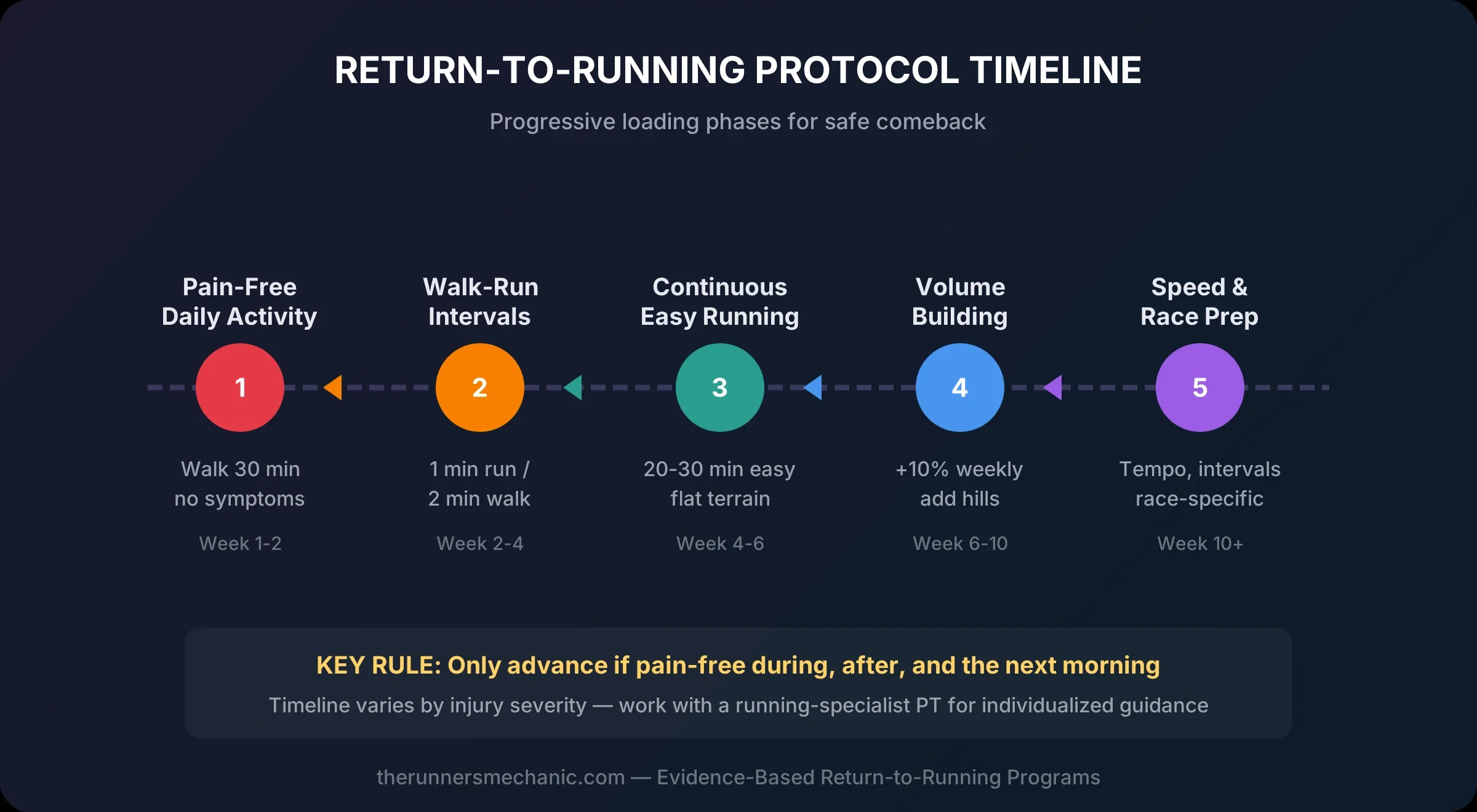
Getting out of pain is step one. Getting back to running without re-injury is the harder, more important part — and it's where most runners blow it by coming back too fast. A structured return-to-running protocol takes the guesswork out of the process.
The Walk-Run Progression
Every credible return-to-running protocol starts with walk-run intervals. The ratio and duration depend on the injury severity, but a typical starting point is 1 minute of running followed by 2 minutes of walking, repeated for 20-30 minutes. Each session, the running interval increases and the walking interval decreases — but only if the previous session was pain-free during, after, and the next morning.
This isn't being conservative for the sake of it. Tendons, bones, and connective tissues adapt to load more slowly than muscles do. Your cardiovascular fitness might be ready to run 5 miles within two weeks of starting back. Your Achilles tendon is not. A return-to-running program designed by a running PT respects those tissue adaptation timelines and prevents the re-injury cycle that sidelines runners for months.
The Milestones That Matter
Before advancing through a return-to-running protocol, you should be able to: perform 25 consecutive single-leg calf raises to full height without pain, hold a single-leg balance for 30 seconds with eyes closed, complete 15 single-leg squats to 60 degrees of knee flexion with good control, hop on the affected leg 20 times without pain, and run at easy pace for 30 minutes continuously with zero symptoms during or within 24 hours after. These aren't arbitrary numbers — they're validated screening criteria used by sports medicine clinics to predict readiness for return to running.
FAQ: Running Physical Therapy
How is running physical therapy different from regular PT?
Running PT focuses exclusively on the biomechanics, loading patterns, and injury mechanisms specific to running. The evaluation includes video gait analysis and running-specific functional tests that a general PT clinic doesn't typically perform. Treatment plans are built around your training goals and return-to-running milestones, not just pain reduction.
Do I need a doctor's referral to see a running physical therapist?
In most states including North Carolina, you can see a physical therapist through direct access without a physician referral. Cash-based clinics like The Runner's Mechanic operate outside insurance networks, so there's no referral requirement. If imaging (X-ray, MRI) is needed, your PT can refer you to a physician for that.
How many PT sessions will I need?
Most running injuries treated at a specialist clinic resolve in 4 to 8 sessions over 6 to 12 weeks. Chronic or complex injuries may require more. The advantage of cash-based PT is that you come as often as you need — not as often as insurance dictates — and sessions are longer and more productive, which reduces the total number needed.
Can I keep running while doing PT?
It depends on the injury. Many running injuries can be managed with modified training — reduced volume, lower intensity, altered surface or terrain — while receiving PT. Your therapist will set specific parameters based on your pain response and injury type. Stress fractures and acute muscle tears typically require a period of no running.
What should I wear to a running PT evaluation?
Wear your normal running shoes and running clothes. If you have multiple pairs of shoes, bring them all — your PT will want to see how each pair affects your mechanics. Bring any orthotics or insoles you currently use. And if you have data from a running watch (cadence, ground contact time, vertical oscillation), bring that too.
Does running physical therapy include a telehealth option?
Many running PT clinics offer telehealth sessions for follow-up visits, program adjustments, and training plan reviews. The initial biomechanical evaluation is best done in person for accurate gait analysis, but subsequent check-ins can often be handled remotely, especially if you can record your own running video.
Is running physical therapy covered by insurance?
Cash-based running PT clinics are typically out-of-network providers. You pay the clinic directly and can submit receipts to your insurance for out-of-network reimbursement if your plan covers it. HSA and FSA funds are accepted at most cash-based PT clinics, which gives you a tax advantage on the cost.
Related Running PT Topics
Go deeper on the specific areas of running physical therapy that matter most to your recovery and performance:
Running Gait Analysis — How frame-by-frame video analysis identifies the mechanical faults behind your injuries
Running Form — The specific biomechanical changes that reduce injury risk and improve efficiency
Strength Training for Runners — The evidence-based strength protocols every runner should follow
Done reading about it? Time to fix it. Whether you're dealing with a nagging injury that won't go away or you want to run faster and stronger without getting hurt, Miriam Salloum and the team at The Runner's Mechanic are ready. One-on-one sessions. Full biomechanical evaluations. Evidence-based treatment. No gimmicks, no generic exercise sheets. Just a specialist who gets runners. Schedule Your Runner's Evaluation — 828-713-0929 | 208 Charlotte Highway, Suite 301, Asheville, NC 28803
This article is for informational purposes only and does not replace a clinical evaluation. Consult a qualified physical therapist or physician for personalized medical advice regarding your running injuries.