

Running Gait Analysis That Actually Fixes Your Pain (Not Just Your Shoes)
Running gait analysis is a clinical video assessment that records your stride from multiple angles while you run on a treadmill. A physical therapist reviews each frame to measure cadence, ground contact time, hip drop, foot strike pattern, and vertical bounce. The evaluation pinpoints the biomechanical faults behind recurring injuries like shin splints, runner's knee, and IT band syndrome. With that data, your therapist builds a gait retraining plan using real-time feedback so you can run pain-free and stay on the road longer.
If you have been dealing with pain that keeps coming back every time you bump up your mileage, you are not stuck with it. Miriam Salloum, MPT, OCS, COMT, has spent over 25 years fixing runners at The Runner's Mechanic in Asheville, NC. Her two-hour Runner's Biomechanical Evaluation includes full video gait analysis and same-day treatment so you can walk out with a real plan. Book your evaluation here or call 828-713-0929 to get started.
Why Running Gait Analysis Matters More Than You Think
Most runners wait until something hurts before they pay attention to how they actually move. By that point the damage has been building for weeks or even months. A proper gait analysis catches the small mechanical issues that snowball into big injuries. It is not about getting a shoe recommendation. It is about seeing, in real video footage, exactly where your body is losing efficiency and absorbing too much force.
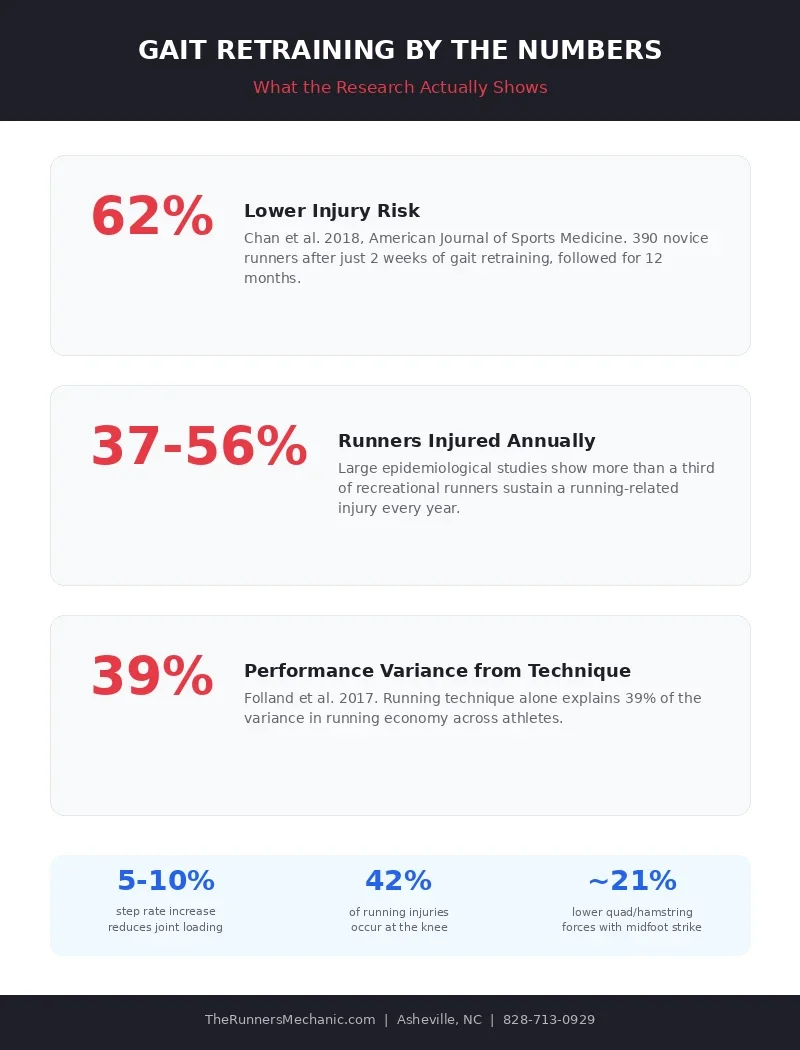
"Approximately 37 to 56 percent of recreational runners sustain a running-related injury every single year."
Large epidemiological studies on recreational runner injury rates
Those numbers are wild, and the frustrating part is that most of those injuries are preventable. When a clinician breaks down your running mechanics frame by frame, they can see the exact moment your knee collapses inward, or your heel strikes too far ahead of your center of mass. That kind of detail is impossible to catch with the naked eye at full speed. Video gait analysis slows everything down so the problem becomes obvious.
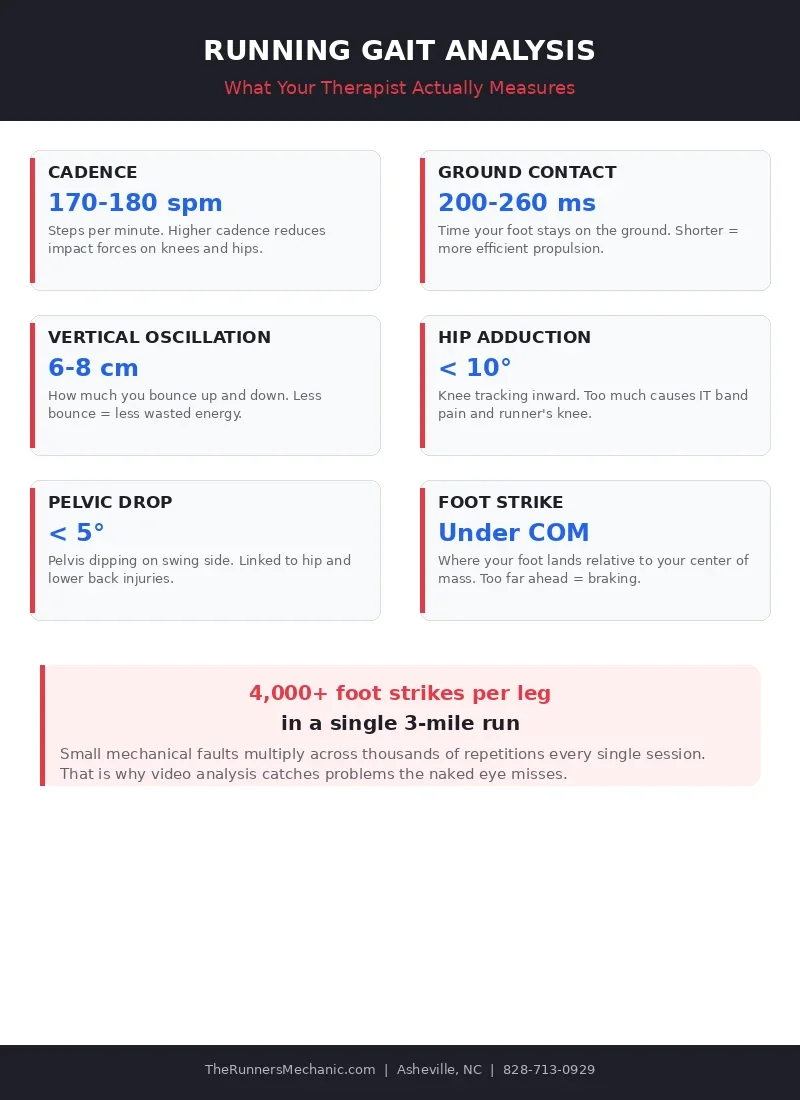
A single three-mile run puts more than 4,000 foot strikes through each leg. Every single one of those impacts sends force up through your ankle, knee, hip, and lower back. If your mechanics are even slightly off, that is 4,000 repetitions of the wrong pattern in just one session. Multiply that across a training week and you can see why injuries pile up so fast.
What a Running Gait Analysis Actually Looks Like
If you have never had one done, you might picture yourself on a treadmill while someone watches you jog for a minute. The clinical version is a lot more thorough than that. A proper assessment starts before you even lace up your shoes.
The Structural Check Before You Run
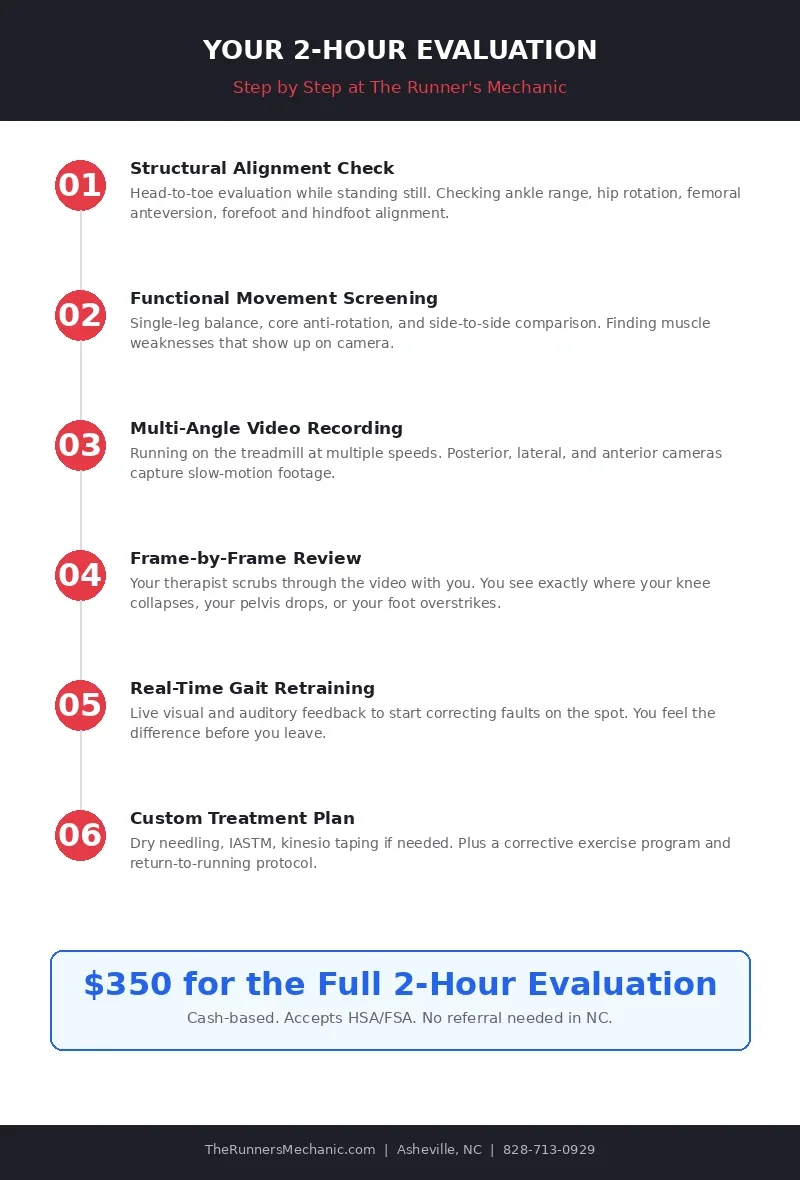
Your therapist starts with a head-to-toe alignment evaluation while you stand still. They check ankle dorsiflexion range, hip internal rotation, femoral anteversion, forefoot and hindfoot alignment, and overall joint mobility. Then they test functional movement. Single-leg balance, core anti-rotation strength, and a comparison of your right versus left side. These static findings give them a roadmap of which mechanical breakdowns are likely to show up on camera once you start running.
The Treadmill Video Recording
At The Runner's Mechanic, runners are recorded from posterior, lateral, and anterior camera angles at multiple speeds. The therapist captures slow-motion video so they can scrub through your stride frame by frame. They are looking at cadence, foot strike position, stride length, vertical oscillation, hip adduction, pelvic drop, trunk lean, arm swing, and ground contact time. Some facilities add pressure plates or wearable sensors for extra force data, but high-quality multi-angle video is the gold standard for identifying running faults.
The Frame-by-Frame Review With You
Here is where the magic happens. Your therapist sits down with you and walks through the footage together. They pause at the exact frames where your knee dives inward, where your foot lands too far ahead, where your pelvis drops on one side. You see the problem on screen and then you understand why that old hip pain keeps flaring up. When you can watch what gait analysis shows in your own body, the corrections start clicking much faster.
The Key Metrics Your Therapist Is Measuring
A trained clinician is not just eyeballing your form. They are measuring specific biomechanical variables that research has linked to injury risk and running economy. Here are the big ones.
Cadence and Step Rate
Cadence is the number of steps you take per minute. It is one of the easiest metrics to change and one of the most impactful. Research from the University of Wisconsin Neuromuscular Biomechanics Lab found that a 5 to 10 percent increase in step rate significantly reduces energy absorption at the knee and hip. That is a huge deal for runners dealing with patellofemoral pain or IT band issues.
"About 56 percent of recreational runners sustain a running-related injury each year, and 42 percent of all running injuries occur at the knee."
University of Wisconsin Neuromuscular Biomechanics Lab
Ground Contact Time
This measures how long your foot stays on the ground during each stride. Longer ground contact time usually means your body is spending more time absorbing impact instead of moving forward. Efficient runners have shorter ground contact times because they are spending energy on propulsion, not on braking forces. Your therapist can spot this immediately on slow-motion video.
Vertical Oscillation
Vertical oscillation is how much your body bounces up and down with each step. Too much vertical bounce wastes energy and puts extra load on your joints. Runners who overstride tend to have higher vertical oscillation because they are essentially launching themselves into the air with each step instead of driving forward. Gait retraining targets this pattern directly.
Hip Adduction and Pelvic Drop
When your hip adducts too much during stance phase, your knee tracks inward. When your pelvis drops on the opposite side, your entire lower chain compensates. These two patterns show up constantly in runners with running physical therapy needs and are closely tied to IT band syndrome, patellofemoral pain, and even stress fractures. They are also some of the most treatable findings because strength training for runners can correct them relatively fast.
Foot Strike Pattern
Your foot strike tells your therapist a lot about how force travels through your body. A heavy rearfoot striker landing well ahead of their center of mass absorbs a large impact spike with every step. Research shows that switching from a rearfoot to a midfoot strike can reduce quadriceps and hamstring forces by about 21 percent, though it increases calf loading by 14 to 28 percent. The right foot strike depends on your body, your injury history, and your goals. There is no universal answer here, and anyone who tells you otherwise is selling shoes, not solving problems.
How Gait Retraining Changes Your Injury Risk
Knowing what is wrong is only half the equation. The other half is fixing it. Gait retraining uses real-time visual or auditory feedback while you run so your nervous system can lock in the corrected pattern. And the research backing it up is genuinely impressive.
"In a randomized controlled trial of over 300 novice runners, gait-retrained runners had a 62 percent lower injury risk than the control group over a 12-month follow-up period."
Chan et al., American Journal of Sports Medicine, 2018
Let that sink in. A 62 percent reduction in injury risk from just two weeks of gait retraining on an instrumented treadmill with visual feedback. The study used 390 novice distance runners, split them into a retraining group and a control group, and tracked them for a full year. Vertical loading rates were significantly lower in the retrained group at both 8 km/h and 12 km/h. Lower loading rates mean less impact slamming through your bones and joints with every step.
A systematic review by Doyle et al. published in the Journal of Orthopaedic and Sports Physical Therapy in 2022 looked at 19 trials with close to 700 runners and found moderate-certainty evidence that step rate retraining lowers vertical loading rates. Two of those trials specifically reported reduced injury rates up to one year after the retraining period. The takeaway is clear. Gait retraining is not just theory. It produces real, lasting changes in how your body handles impact.
What Real-Time Feedback Looks Like in Practice
At The Runner's Mechanic, Miriam uses live video feedback on a treadmill so you can watch yourself correct a movement pattern in real time. If your knee is collapsing inward, you see it happening on screen and you adjust on the spot. If your cadence is too low, you get an auditory metronome cue while you run. The protocols are modeled after the UVA Speed Clinic and Harvard's Spaulding National Running Center, which are two of the top running physical therapy programs in the country.
Who Actually Needs a Running Gait Analysis
The short answer is every runner. But if that feels too broad, here are the situations where a gait analysis goes from helpful to absolutely necessary.
Runners With Recurring Injuries
If you keep getting the same injury every time you push past a certain mileage, your mechanics are almost certainly part of the problem. Shin splints that come back every spring, knee pain that flares at mile 8, hip tightness that never fully clears. These patterns are your body telling you that something in your stride is loading one structure too hard. A gait analysis identifies the exact fault so your therapist can fix the cause, not just treat the symptom.
New Runners Building a Base
Starting a running habit is exciting, but new runners are at the highest risk for injury. Research shows that up to 85 percent of new runners training for an event will hurt themselves in a given year. Getting a baseline gait analysis early means you can catch and correct bad patterns before they get grooved in. It is way easier to fix your stride when you have been running for three months than when you have been running with the same faults for three years.
Experienced Runners Changing Their Training
Adding speed work, switching to trails, increasing weekly mileage, coming back from time off. Any significant training change shifts how forces move through your body. Experts recommend reassessing your gait yearly, or whenever you make a big shift in training volume or surface. Even subtle changes in body weight, shoe type, or cross-training can alter your mechanics enough to create new stress points.
Post-Injury Runners Returning to the Road
If you have been cleared to run again after a stress fracture, tendon issue, or surgical recovery, a gait analysis before you ramp back up is non-negotiable. Your body likely developed compensatory patterns while you were injured. A return to running program built on gait analysis data makes sure you are not layering new miles on top of old compensations.
Shoe Store Analysis vs. Clinical Gait Analysis
A lot of runners think they have had a gait analysis because someone at a running store watched them jog on a treadmill for 30 seconds and recommended a stability shoe. That is not a gait analysis. That is a shoe fitting. There is a massive difference.
A shoe store assessment typically lasts about 15 to 20 seconds of running, recorded from one angle, reviewed by a retail employee. The goal is to sell you the right shoe category. A clinical gait analysis at a running physical therapy clinic runs for a full evaluation at multiple speeds, recorded from three or more camera angles, reviewed frame by frame by a licensed physical therapist. The goal is to identify biomechanical faults that are causing or will cause injury, and then fix them through hands-on treatment, gait retraining, and a corrective exercise program.
At The Runner's Mechanic, the All-Inclusive Runner's Evaluation and Initial Treatment Session runs for two full hours at $350. That includes video gait analysis, structural alignment evaluation, functional movement screening, muscle strength and flexibility testing, real-time gait retraining, and same-day treatment. You walk out with a corrective home exercise program and a clear picture of exactly what needs to change. Telehealth evaluations with video analysis are also available at the same rate if you are not local to Asheville.
"Running technique explains about 39 percent of the variance in running economy and 31 percent of the variance in performance."
Folland et al., 2017
That stat is wild when you think about it. Nearly 40 percent of how efficiently you run comes down to technique. Not fitness. Not shoes. Technique. That is exactly what a clinical gait analysis is designed to break down and improve.
What Happens After Your Gait Analysis
The evaluation is just the starting point. After your therapist identifies your mechanical issues, they build a personalized plan that typically includes several components working together.
Gait Retraining Sessions
Using real-time feedback, you practice running with corrected patterns. This might mean targeting a higher cadence, adjusting your trunk position, or changing your foot strike. The research from Chan et al. showed that just two weeks of retraining with visual feedback produced lasting changes over a full year. Most runners need two to four sessions to lock in a new pattern.
Corrective Exercises and Strength Work
Strength training for runners targets the specific weaknesses your analysis revealed. If your hip drops because your glute medius is weak, you get loaded single-leg exercises. If your ankle dorsiflexion is limited, you get mobility drills. The program is not generic. It is built directly from your assessment data.
Hands-On Treatment
Depending on your evaluation, your therapist may use trigger point release, intramuscular dry needling, instrument-assisted soft tissue mobilization, kinesio taping, or spinal manipulation. At The Runner's Mechanic, these treatments happen during your initial evaluation. You do not have to wait three visits before anyone actually works on you.
A Structured Return-to-Running Plan
Your therapist prescribes a return to running program with specific duration, volume, terrain, and intensity guidelines. This is not a generic "run three times a week" plan. It is built around your injury, your gait data, and your goals.
Why The Runner's Mechanic Is Built for This
You would be glad to know that The Runner's Mechanic in Asheville, NC is one of the few clinics in the region that offers a full two-hour biomechanical evaluation with video gait analysis and same-day treatment included. Miriam Salloum has been treating runners since 2000 and brings a background that most PTs simply do not have. She completed an internship at Mayo Clinic's biomechanics and motion analysis lab. She served as the physical therapist at an Olympic Training Site, rehabilitating Olympic bobsled and track and field athletes. She is an Orthopedic Certified Specialist through the APTA and holds a Certification in Orthopedic Manual Therapy through the Maitland-Australian Physiotherapy program.
Her clinical model is patterned after the UVA Speed Clinic and Harvard's Spaulding National Running Center. That means every runner gets the same caliber of assessment that elite athletes receive at major university programs. Whether you are training for your first 5K or chasing a Boston qualifier, the evaluation protocol does not change. You get the full picture of what gait analysis shows in your stride, plus a hands-on treatment plan built around your specific findings.
The clinic is cash-based, which means no insurance gatekeepers deciding how many visits you get or what treatments are covered. Follow-up sessions are available at $155 for a full hour, $135 for 45 minutes, or $100 for 30 minutes. HSA and FSA funds are accepted. And if you are not in the Asheville area, telehealth evaluations with video analysis are available at the same $350 rate.
Frequently Asked Questions About Running Gait Analysis
How much does a running gait analysis cost
At specialty running stores, a basic shoe-fitting assessment is usually free. A clinical gait analysis at a physical therapy clinic typically ranges from $150 to $350, depending on the length of the session and what is included. At The Runner's Mechanic, the All-Inclusive Runner's Evaluation with video gait analysis and same-day treatment is $350 for a full two-hour session.
How long does a gait analysis take
A store-level assessment usually runs about 15 to 20 minutes. A clinical evaluation at a running physical therapy clinic takes significantly longer because it includes a full structural evaluation, functional movement screening, treadmill video recording, frame-by-frame review, and treatment. At The Runner's Mechanic, the initial evaluation is a full two hours.
Do I need a referral for a gait analysis
In North Carolina, you do not need a physician referral to see a physical therapist. Direct access laws allow you to book online and schedule your evaluation directly. This is true at The Runner's Mechanic and at most cash-based clinics across the state.
How often should I get my gait analyzed
Experts recommend a gait analysis at least once a year, or whenever you make a significant change to your training. That includes bumping up weekly mileage by more than 20 percent, switching from road to trail, coming back from an injury, changing your shoe type, or gaining or losing a significant amount of weight.
Can gait analysis help with shin splints
Absolutely. Shin splints are one of the most common findings tied to specific gait faults. Overstriding, low cadence, and excessive heel striking all increase tibial loading. A small cadence increase of just 5 to 7 percent has been shown to reduce joint loading in many runners. Your therapist identifies the pattern and retrains it through real-time feedback.
Is a treadmill gait analysis accurate compared to outdoor running
Research shows that treadmill running mechanics closely match overground running mechanics for most variables. The main difference is that a treadmill provides a consistent, controlled surface, which actually makes it easier to isolate and measure gait variables. Some clinics also do outdoor video capture, but the treadmill remains the standard for clinical gait analysis because of the control it provides.
Whether you are struggling with a nagging injury or just want to run smarter and faster, a full gait analysis is the first real step toward fixing what is holding you back. The Runner's Mechanic Physical Therapy Clinic at 208 Charlotte Highway, Suite 301, Asheville, NC 28803 is accepting new patients for in-person and telehealth evaluations. Reach out at 828-713-0929 or email runnersmechanic@gmail.com to set up your two-hour Runner's Biomechanical Evaluation with Miriam Salloum.
This article is for informational purposes only and does not replace professional medical advice. If you are experiencing pain or injury, please consult a licensed physical therapist or healthcare provider for a personalized evaluation.