
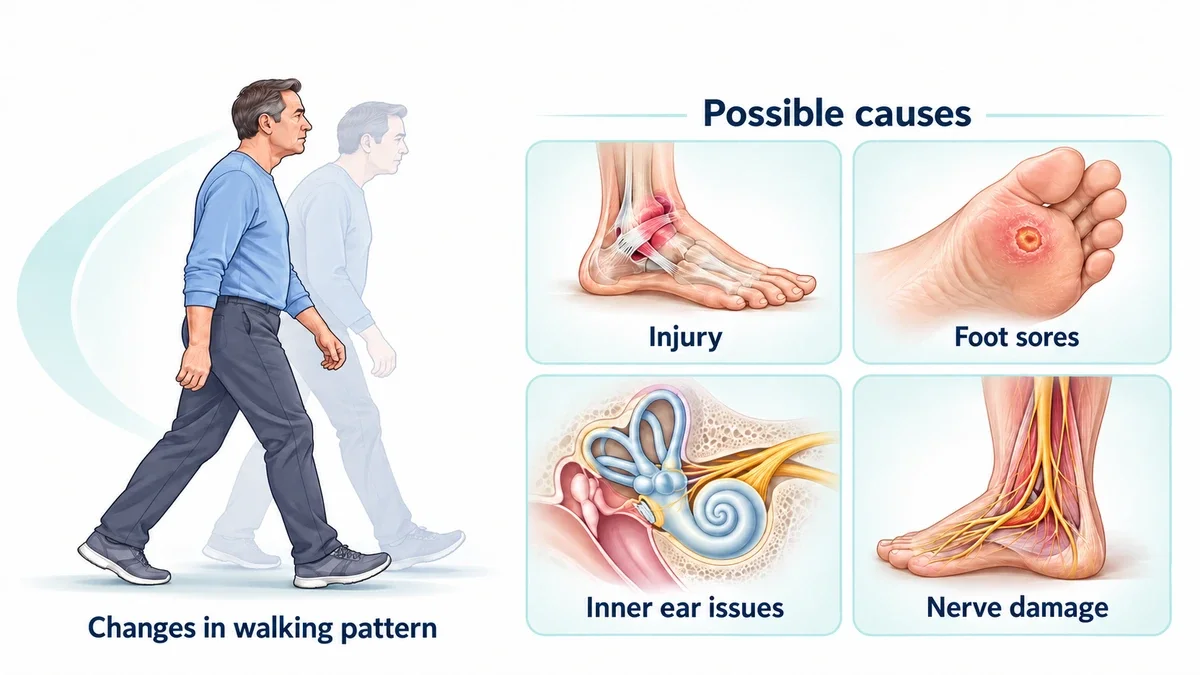
What Gait Analysis Shows: 7 Hidden Faults a Gait Analysis Reveals That Keep Injuring You
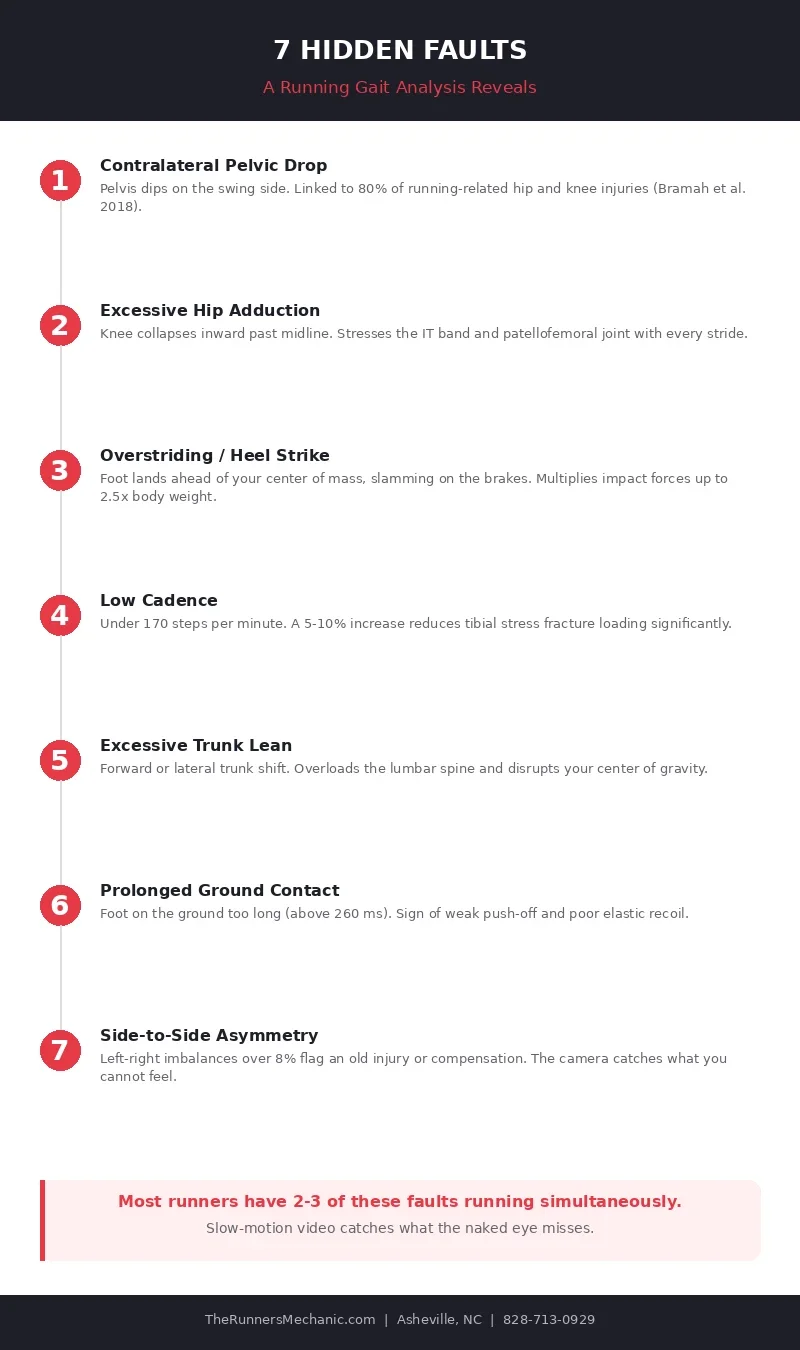
A running gait analysis shows the biomechanical patterns behind recurring running injuries by recording multi-angle slow-motion video on a treadmill and measuring clinical metrics including contralateral pelvic drop, hip adduction angle, cadence, ground contact time, vertical oscillation, foot strike position, and trunk lean. Published research from Bramah et al. found that each single degree increase in pelvic drop raises a runner's injury risk by 80 percent. These findings let a physical therapist build a targeted gait retraining and corrective exercise program that addresses the root cause, not just the symptom.
Tired of getting the same generic advice about your running pain? Miriam Salloum, MPT, OCS, COMT, uses frame-by-frame video analysis during her two-hour Runner's Biomechanical Evaluation at The Runner's Mechanic in Asheville, NC. She will show you the exact mechanical faults in your stride and start fixing them on the same visit. Schedule your evaluation or call 828-713-0929.
What Gait Analysis Actually Reveals About Your Running
A running gait analysis is not a quick glance at your feet while you jog. It is a structured clinical evaluation that captures high-speed video of your entire body in motion from three different angles. Your physical therapist then scrubs through that footage frame by frame, measuring specific variables that research has directly linked to injury.
The whole point of a gait analysis is to answer one question. Why do you keep getting hurt? Not what shoe you need. Not whether you pronate. The real question is which specific biomechanical pattern in your stride is loading a structure past its tolerance, and what exactly needs to change to stop it.
"Each single degree increase in contralateral pelvic drop was associated with an 80 percent greater odds of sustaining a running-related injury."
Bramah et al., American Journal of Sports Medicine, 2018
That is a massive number. One degree. Something you would never notice yourself and your running buddy would never catch by watching you on the trail. But a clinician reviewing slow-motion video can measure it precisely. That is the difference between guessing and knowing, and it is exactly what gait analysis shows when a trained eye is behind the camera.
Contralateral Pelvic Drop and Why It Predicts Injury
Contralateral pelvic drop, sometimes called a Trendelenburg sign during running, happens when the pelvis on your swing-leg side sinks lower than the stance-leg side. Your hip abductors and glute medius are supposed to hold the pelvis level. When they cannot keep up with the demands of running, that drop shows up on every single stride.
The Bramah et al. study from 2018 in the American Journal of Sports Medicine looked at 72 injured runners and 32 healthy controls. They found that contralateral pelvic drop was one of the two strongest predictors of injury out of every variable they measured. The other was knee extension at initial contact, which we will get to next. What makes pelvic drop so dangerous is the chain reaction it sets off. When your pelvis drops, your knee on the stance side is forced into a valgus position. Your IT band gets stretched and loaded. Your lower back compensates with lateral flexion. One fault cascades into three or four problems down the chain.
Dingenen et al. published a 2019 study in Physical Therapy in Sport with 42 runners that backed this up. Injured runners showed significantly greater pelvic drop compared to their healthy counterparts. It is one of the most reliable red flags a clinician can spot on video, and it is also one of the most fixable through targeted strength training for runners that focuses on hip abductor loading.
"Injured runners demonstrated significantly greater contralateral pelvic drop and peak hip adduction compared to healthy controls during treadmill running."
Dingenen et al., Physical Therapy in Sport, 2019
Hip Adduction Angle and the Knee Collapse Problem
Hip adduction is the inward movement of your thigh toward the midline during stance phase. When your hip adducts too much, your knee tracks inward past your foot. You might know this as "knee valgus" or "knee collapse." It looks like your knee is caving in every time your foot hits the ground, and it is one of the most common patterns linked to IT band syndrome, patellofemoral pain, and medial tibial stress syndrome.
On video, your therapist measures the angle between your femur and the vertical line of your pelvis at mid-stance. The Bramah study found that excessive hip adduction showed up consistently across all four injury subgroups they examined, which included patellofemoral pain, IT band syndrome, medial tibial stress syndrome, and Achilles tendinopathy. It was not specific to one injury. It was a risk factor for all of them.
The fix involves targeted hip strengthening, specifically loaded exercises for the gluteus medius and external rotators. Single-leg deadlifts, lateral band walks with a forward lean, and Copenhagen planks are staples. But the key is that your therapist does not just hand you generic exercises. They see the exact degree of adduction on video, prescribe the specific strengthening protocol, and then verify on a follow-up analysis that the angle has improved.
Foot Strike Pattern and the Overstriding Trap
Foot strike gets more attention than almost any other running variable, and most of that attention is focused on the wrong thing. The question is not whether you are a heel striker or a forefoot striker. The question is where your foot lands relative to your center of mass.
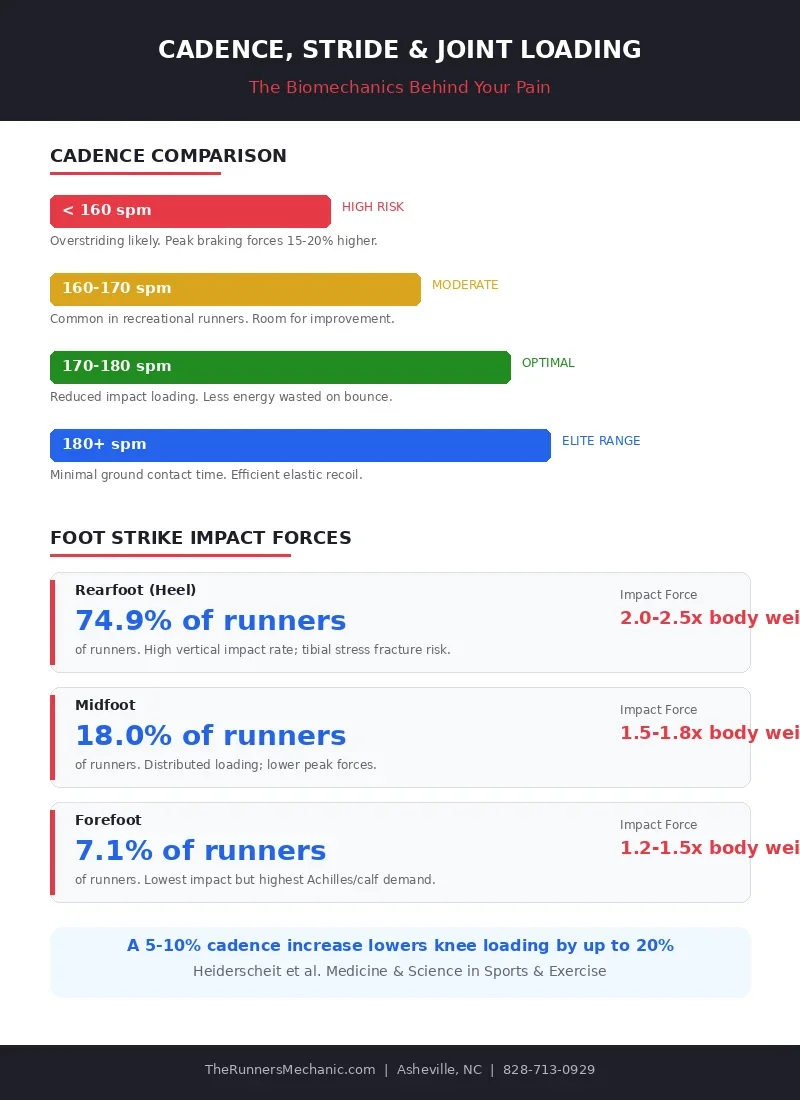
When your foot lands well ahead of your body, you are overstriding. Every time that happens, you create a braking force that travels straight up through your tibia, knee, and hip. Studies from Hasegawa et al. at the Hakone Ekiden found that roughly 75 percent of distance runners are rearfoot strikers, about 24 percent are midfoot strikers, and only 1 percent are forefoot strikers. Rearfoot striking is not inherently bad. Overstriding is.
"Switching from a rearfoot to a midfoot strike pattern can reduce quadriceps and hamstring loading by approximately 21 percent, though it increases plantar flexor demands by 14 to 28 percent."
Biomechanical comparison studies on foot strike patterns
This is why a blanket recommendation to "switch to forefoot running" can actually cause new injuries. Your calf and Achilles take on significantly more load when you move away from heel striking. A gait analysis shows your therapist exactly how you are striking, how far ahead of your center of mass your foot lands, and what the safest correction pathway looks like for your body. There is no one-size-fits-all answer here, and running form adjustments always need to be individualized.
Cadence Changes That Lower Joint Loading
Cadence is simply the number of steps you take per minute. It is one of the most studied and most actionable variables in gait retraining. The landmark work from Heiderscheit and the University of Wisconsin Neuromuscular Biomechanics Lab showed that increasing your step rate by just 5 to 10 percent significantly reduces the energy your knee and hip joints have to absorb with each stride.
Here is why that works. A higher cadence naturally shortens your stride length. A shorter stride means your foot lands closer to your center of mass. A foot landing closer to your center of mass means less braking force, less overstriding, and less impact slamming through your joints. It is a domino effect, and it starts with a single number on a metronome.
"A 5 to 10 percent increase in step rate significantly reduces energy absorption at the knee and hip during running."
Heiderscheit et al., Medicine and Science in Sports and Exercise, 2011
Most recreational runners land somewhere between 155 and 165 steps per minute. Research suggests that 170 to 180 is a more efficient range for most runners, though the ideal number depends on your height, leg length, pace, and running goals. Your therapist measures your actual cadence on video and prescribes a specific target increase. During gait retraining sessions, you practice hitting that new cadence with a metronome cue while running on the treadmill. Most runners can feel the difference in joint comfort within the first session.
Trunk Lean and Forward Posture Findings
Your trunk position during running affects everything downstream. Too much forward lean shifts your center of mass ahead and changes how your foot contacts the ground. Too little forward lean, running too upright, can increase vertical oscillation and reduce your ability to use elastic recoil from your tendons.
The Bramah et al. study found that forward trunk lean at initial contact was present across all four injury subgroups they studied. Runners with patellofemoral pain, IT band issues, shin splints, and Achilles tendinopathy all demonstrated excessive forward trunk lean compared to healthy runners. It is one of those variables that does not get talked about as often as foot strike or cadence, but it shows up in the data just as consistently.
Your therapist measures trunk lean angle on the lateral camera view. Even a few degrees of excessive lean changes the loading pattern through your spine, pelvis, and knees. Correcting it often involves core anti-rotation and anti-extension work, plus real-time visual cueing during treadmill retraining. Runners who do uphill drills and downhill eccentric strengthening tend to develop better trunk control on varied terrain as well.
Ground Contact Time and Vertical Oscillation
These two metrics are closely related and they both tell your therapist how efficiently you are converting energy into forward motion.
Ground contact time is how long your foot stays on the ground during each stride, measured in milliseconds. Efficient runners typically land in the 200 to 260 millisecond range. Longer ground contact times usually mean your body is spending more time absorbing impact and less time propelling you forward. It is a strong indicator of running economy, and it tends to improve naturally when cadence increases and overstriding decreases.
Vertical oscillation measures how much your body bounces up and down with each step. The ideal range is generally 6 to 8 centimeters. Too much vertical bounce means energy is being wasted going up instead of going forward. Your therapist spots this easily on the lateral camera view by tracking the position of your head or hip marker across multiple strides. High vertical oscillation usually pairs with low cadence and overstriding, so fixing one often fixes the other.
"Running technique alone explains approximately 39 percent of the variance in running economy across trained athletes."
Folland et al., 2017
Almost 40 percent of how efficiently you run comes down to technique. Not aerobic fitness. Not body composition. Technique. Ground contact time and vertical oscillation are two of the clearest windows into that efficiency, and they are both measurable on a standard gait analysis video.
Asymmetry and Side-to-Side Differences
One of the most valuable things a gait analysis shows is something most runners never think about. Left-right asymmetry. Your body is not perfectly symmetrical, and neither is your running stride. A small degree of natural asymmetry is normal. But when the difference between sides crosses a certain threshold, it starts predicting injury.
Research has found that asymmetry in ground contact time, stride length, and vertical loading rate is common in injured runners. Your right leg might have a ground contact time of 240 milliseconds while your left leg sits at 275 milliseconds. That 35-millisecond gap might not sound like much, but it means your left leg is absorbing more impact on every single stride. Over 4,000 foot strikes per leg in a three-mile run, those asymmetries add up fast.
A therapist reviewing your multi-angle video compares your right and left side for pelvic drop, hip adduction, knee flexion angle, foot strike position, and arm swing. If your right pelvis drops more than your left, that tells them your left hip abductors are weaker. If your left foot overstrikes more than your right, that points to a flexibility or motor control issue on one side. These side-to-side comparisons are often the fastest path to finding the root cause of a runner's pain, especially for chronic hamstring pain and other unilateral injuries that keep showing up on the same side.
How These Findings Build Your Treatment Plan
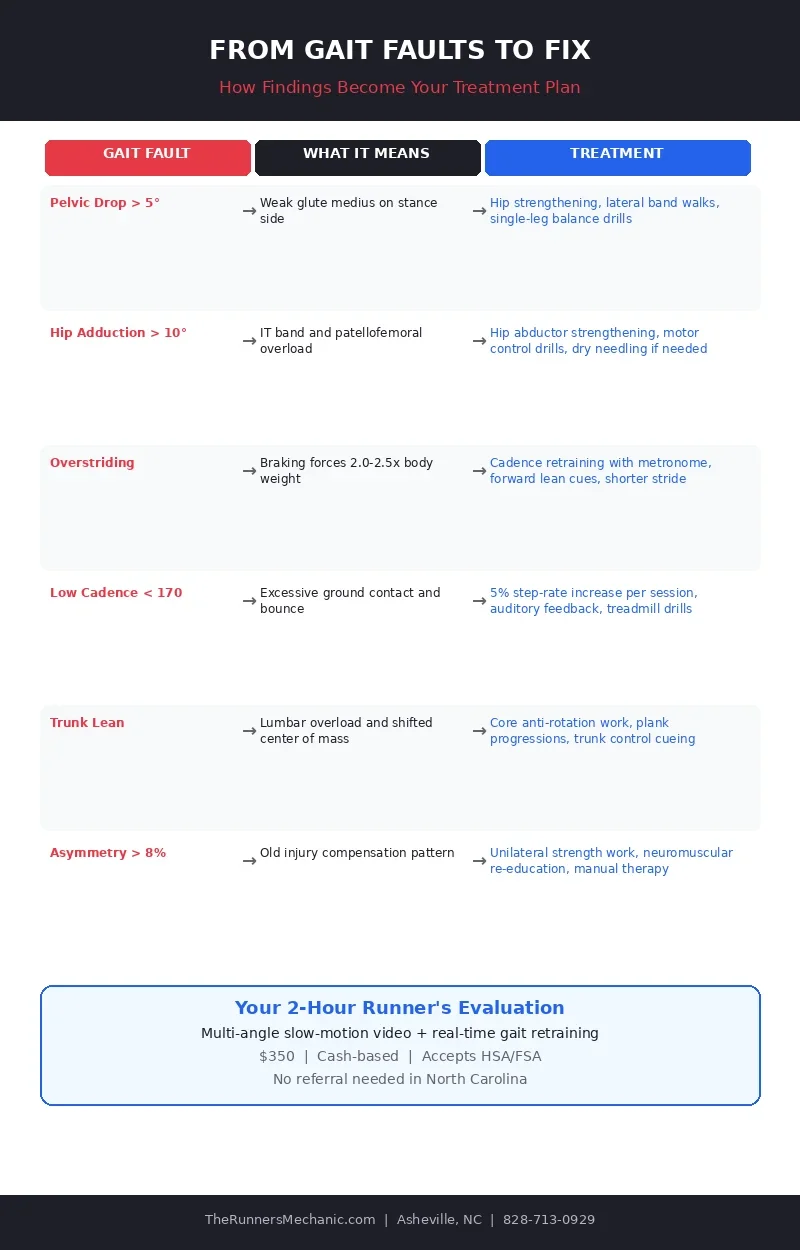
The metrics above are not just data points on a screen. Every single finding from your gait analysis feeds directly into a treatment plan that targets your specific breakdowns. This is what separates a clinical gait analysis from a shoe store jog test.
Gait Retraining With Real-Time Feedback
Once your therapist identifies the fault, they put you back on the treadmill with live video feedback. You watch yourself running on screen in real time and make corrections while you see the effect. If your pelvic drop is the issue, you focus on keeping your pelvis level while watching it happen live. If your cadence is low, you match a metronome target while feeling the difference in your joints. A landmark RCT by Chan et al. found that just two weeks of this kind of retraining lowered injury rates by 62 percent over a 12-month follow-up.
Targeted Corrective Exercises
Your therapist prescribes strength training that targets the exact muscle groups your analysis flagged. Weak hip abductors get loaded progressively. Limited ankle dorsiflexion gets mobility work. Poor core anti-rotation gets stability programming. The exercises are not pulled from a generic handout. They are built from what the video showed in your stride.
Hands-On Treatment
At The Runner's Mechanic, same-day treatment is part of the initial evaluation. Depending on your findings, that might include trigger point dry needling, instrument-assisted soft tissue mobilization, kinesio taping, or joint mobilization. If your calf tightness is contributing to an Achilles overload pattern that showed up on video, your therapist addresses that tissue restriction the same day rather than scheduling a separate treatment visit.
A Structured Return-to-Running Protocol
If you are coming back from an injury, your therapist builds a return to running program around your gait findings. The volume, intensity, terrain, and progression are all dictated by what the analysis showed. If your pelvic drop gets worse at faster speeds, your speed work gets phased in later. If your overstriding only appears after 20 minutes of running, your run durations start below that threshold and build gradually.
Why The Runner's Mechanic Sees What Others Miss
Not all gait analyses are created equal. The quality of the assessment depends entirely on who is behind the camera and what they know how to look for. At The Runner's Mechanic in Asheville, NC, Miriam Salloum brings credentials and clinical experience that most physical therapists simply do not have.
She completed an internship at Mayo Clinic's biomechanics and motion analysis lab, where she trained under researchers who study human movement at the highest level. She served as the physical therapist at an Olympic Training Site, working with Olympic bobsled and track and field athletes. She has been studying under Sue Falsone since 2015 and is a national presenter for North American Seminars. She holds an Orthopedic Certified Specialist designation through the APTA and a Certification in Orthopedic Manual Therapy.
Her clinical model is patterned after the UVA Speed Clinic and Harvard's Spaulding National Running Center. That means you get the same caliber of biomechanical evaluation that division-one and professional athletes receive at top university programs. The two-hour All-Inclusive Runner's Evaluation at $350 includes video gait analysis from multiple angles, full structural alignment evaluation, functional movement screening, muscle strength and flexibility testing, real-time gait retraining, and same-day hands-on treatment. You walk out with a corrective exercise program and a return to running plan built around your specific data.
The clinic is cash-based with no insurance gatekeepers deciding your care. HSA and FSA are accepted, and North Carolina's direct access law means you do not need a physician referral to book your evaluation. If you are not local to Asheville, telehealth evaluations with video analysis are available at the same rate. Follow-up sessions run $155 for an hour, $135 for 45 minutes, or $100 for 30 minutes.
Frequently Asked Questions About What Gait Analysis Shows
What metrics does a running gait analysis measure
A clinical running gait analysis measures contralateral pelvic drop, hip adduction angle, cadence, ground contact time, vertical oscillation, foot strike position relative to center of mass, trunk lean angle, stride length, and left-right asymmetry. The therapist also evaluates knee flexion at initial contact, arm swing symmetry, and ankle dorsiflexion during stance phase. Each metric has a research-backed threshold that helps identify injury risk.
Can a gait analysis predict which injuries I am likely to get
Yes, to a significant degree. Research from Bramah et al. showed that specific gait patterns are associated with specific injury types. Excessive pelvic drop and hip adduction are linked to IT band syndrome and patellofemoral pain. Overstriding and low cadence are linked to tibial stress injuries. Excessive forward trunk lean appeared across all injury subgroups studied. While a gait analysis cannot guarantee you will or will not get hurt, it identifies the mechanical patterns that substantially raise your risk.
How is a clinical gait analysis different from a wearable running watch
Wearable devices like GPS watches and running pods can estimate cadence, ground contact time, and vertical oscillation. However, they cannot measure pelvic drop, hip adduction, knee valgus, trunk lean, foot strike position relative to center of mass, or left-right asymmetry with clinical accuracy. A clinical gait analysis uses multi-angle slow-motion video reviewed frame by frame by a licensed physical therapist who can connect the visual findings to your injury history and prescribe a treatment plan. The watch gives you numbers. The therapist gives you answers.
Do I need to be injured to get a gait analysis
No. In fact, getting a gait analysis before you are injured is one of the smartest things a runner can do. A baseline assessment identifies mechanical patterns that put you at risk before they cause symptoms. Research shows that up to 56 percent of recreational runners get injured every year, and most of those injuries are tied to biomechanical faults that were present long before the pain started.
How long do gait retraining results last
Research from Chan et al. tracked runners for 12 months after a two-week gait retraining program and found that the retrained group maintained significantly lower vertical loading rates at both follow-up testing points. The motor pattern changes appear to be durable when paired with a consistent corrective exercise program. Most runners need two to four retraining sessions to lock in the new pattern, followed by independent practice using metronome or video cues.
Does running on a treadmill change my gait compared to outdoor running
Multiple studies have shown that treadmill and overground running produce similar biomechanical patterns for the variables clinicians measure during a gait analysis. The treadmill provides a controlled, repeatable environment that allows precise speed matching and consistent camera positioning. Some runners feel slightly different on a treadmill, but the mechanical patterns your therapist is measuring, like pelvic drop, hip adduction, and cadence, stay consistent between surfaces. If you also run on trails, tips for trail running form adjustments can complement your treadmill-based analysis.
More on Running Gait Analysis
This page is part of our running gait analysis resource center under the broader running physical therapy section. For a deeper look at the topics covered here, check out these related pages.
Running Gait Analysis covers the full process of a clinical biomechanical evaluation and why it matters for injury prevention. Read the full guide.
Gait Retraining explains how real-time visual and auditory feedback rewires your running mechanics and the science behind lasting motor pattern changes. See how gait retraining works.
Return to Running Program is a structured plan for getting back on the road safely after injury, built on your gait analysis data and individualized to your findings. View the return to running protocol.
Running Form breaks down the fundamentals of efficient running mechanics and how to put them into practice on every run. Check out running form tips.
Strength Training for Runners features targeted exercises that fix the muscle weaknesses your gait analysis reveals, including hip abductor and core stability programming. See the strength training guide.
Now you know exactly what a gait analysis measures and why each variable matters for keeping you healthy on the road. The next step is getting your own stride on camera. The Runner's Mechanic Physical Therapy Clinic at 208 Charlotte Highway, Suite 301, Asheville, NC 28803 is accepting new patients for in-person and telehealth evaluations. Call 828-713-0929 or email runnersmechanic@gmail.com to set up your two-hour Runner's Biomechanical Evaluation with Miriam Salloum and find out exactly what your gait has been trying to tell you.