

IT Band Syndrome: Why “Tight” Isn’t the Whole Story
If you're a runner, chances are you've either dealt with IT band syndrome (ITBS) or know someone who has. It's one of the most common overuse injuries in runners, showing up as a sharp or burning pain on the outside of the knee — often appearing like a few miles into a run, and flaring with downhill more than uphill.
What Is the IT Band, Really?
The iliotibial (IT) band is a thick, fibrous band of connective tissue that runs from the hip down the outside of the thigh to just below the knee. It connects with the glute max and the tensor fasciae latae (TFL) at the hip. Despite popular belief, the IT band itself isn't a muscle — it can't be “stretched” or “loosened” the way a muscle can. It's dense, strong, and largely non-contractile and it is considered to act like a tendon that absorbs impact for landing and push off during running.
So What's Actually Causing the Pain?
For years, ITBS was explained as simple friction — the band rubbing back and forth over a bony bump at the knee (the lateral femoral epicondyle) as the knee bends and straightens. That's part of the picture, but more recent research describes what really elicits pain is the IT Band compressing, or “pinching”, the underlying fat between itself and the knee. This area is highly innervated with nerve endings and can also result in inflammation.
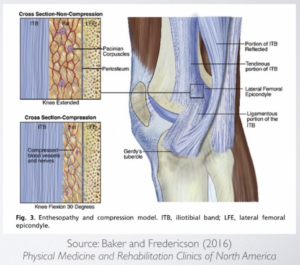
Several factors can contribute to IT Band Syndrome.
1)Mechanics: When the hip isn't stable, the knee tends to drift inward with each stride. That subtle collapse changes the angle at which the IT band crosses the knee, increasing compression and irritation at that same spot each step. Runners take approximately 1600 steps pre mile.
2) Training Errors: A sudden jump in mileage, too much downhill running, or worn-out shoes, and you've got a recipe for ITBS.
3)Terrain: Running narrow trails creates tension at the IT Band due to the feet having to land close together (called a narrow step width) and creating a sharper hip angle. Also trail running entails a lot of long and steeper downhill terrain which greatly increases loads at the IT Band
4)Fun Fact: According to current research, weak hips are not correlated as a cause of IT Band Syndrome, but hip strengthening is supported in the research as an essential part of getting better.
Why Foam Rolling Isn't the Fix
This is a big one: research using shear wave elastography has found no meaningful difference in IT band stiffness between injured and healthy runners. In other words, “tightness” in the band itself doesn't appear to be the real problem — so aggressively foam rolling it usually doesn't solve anything. Some runners find rolling the surrounding muscles (like the TFL and vastus lateralis) helpful for comfort, but it's not addressing the actual cause.
What Actually Helps
1. Build hip stability. Glute medius and glute max strengthening (think side planks, clamshells, single-leg bridges, and single-leg squats) is the cornerstone of treatment.
2. Look at your form. A physical therapist who works with runners can assess your gait for issues like overstriding, low cadence, or excessive hip drop — all of which load the IT band unevenly.
3. Manage your training load. Sudden increases in mileage or hill work are common triggers. A general rule: don't increase weekly mileage by more than about 10%.
4. Address it early. ITBS tends to respond well to treatment when caught early, but can become stubborn and recurring if runners keep pushing through pain.
5. Get a proper evaluation. Because ITBS often stems from biomechanics rather than the band itself, a runner-specific PT assessment can identify why it's happening for you individually — not just treat the symptom. Also a gradual tendon loading and strength progression is essential for returning successfully in the long run. Always remember there are “differential diagnosis” possibilities, and lateral knee pain does not always mean IT Band. Diagnosing pain accurately is the MOST important step.
The Bottom Line
IT band syndrome isn't really about a “tight band.” It's usually a signal that something upstream — most often running mechanics, muscular stability, or training errors — needs attention. The good news: with the right strengthening and gait adjustments, most runners with ITBS get back to pain-free miles.