
Hip Drop When Running
TL;DR
Hip drop happens when the pelvis on your swing-leg side sinks below your stance-leg side during each stride. It usually traces back to a gluteus medius that can't stabilize the pelvis under running loads, not a structural problem. Research from Bramah et al. (2018) found that each additional degree of contralateral pelvic drop raised the odds of being classified as injured by roughly 80 percent, making it one of the strongest gait-related injury predictors identified so far. The good news is that targeted hip strengthening and gait retraining can reduce hip drop and the chain of compensations it triggers. A running-focused gait analysis measures pelvic drop in real time so you know exactly how much correction you need.
What Hip Drop Actually Looks Like Mid-Stride
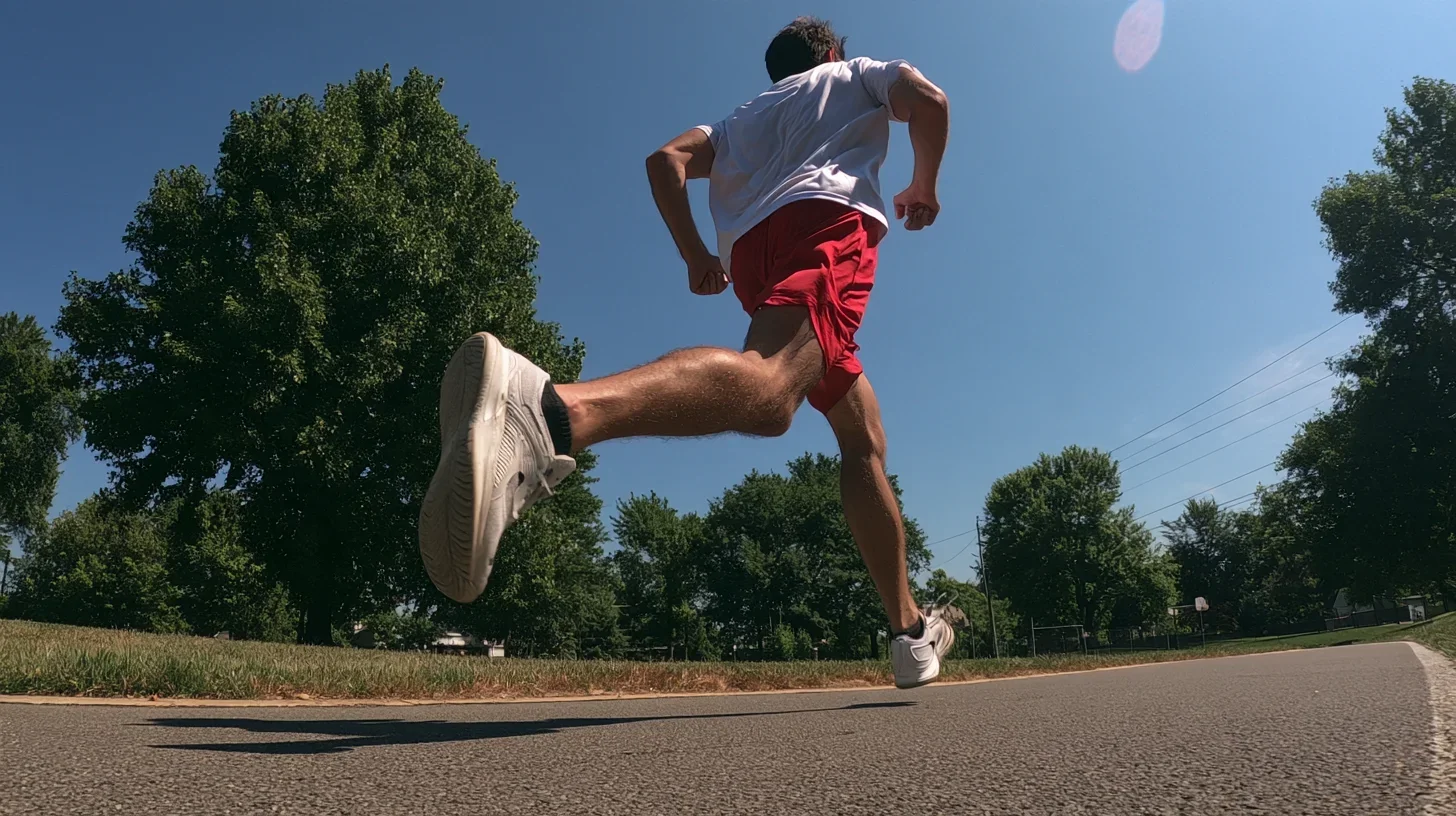
From behind, a runner with hip drop looks slightly lopsided on every step. As the right foot hits the ground and supports the body, the left side of the pelvis dips below the right. Then the roles reverse. A small amount of this motion is normal because the pelvis naturally tips a few degrees during the gait cycle, but when the drop exceeds what the hip abductors can control, it becomes a performance issue and, eventually, an injury risk.
If you've been told you have a Trendelenburg gait or a positive Trendelenburg sign, that's the clinical name for the same pattern. The test is straightforward: stand on one leg, and if the opposite hip drops instead of staying level or rising slightly, your stance-leg hip abductors aren't holding the pelvis where it should be.
At The Runner's Mechanic in Asheville, running physical therapy sessions include a detailed video gait analysis that captures pelvic drop from multiple angles on the treadmill. Miriam Salloum, MPT, uses slow-motion playback and frame-by-frame measurements to quantify exactly how many degrees your pelvis drops on each side, so the treatment plan addresses real numbers, not guesswork.
Why the Gluteus Medius Matters So Much
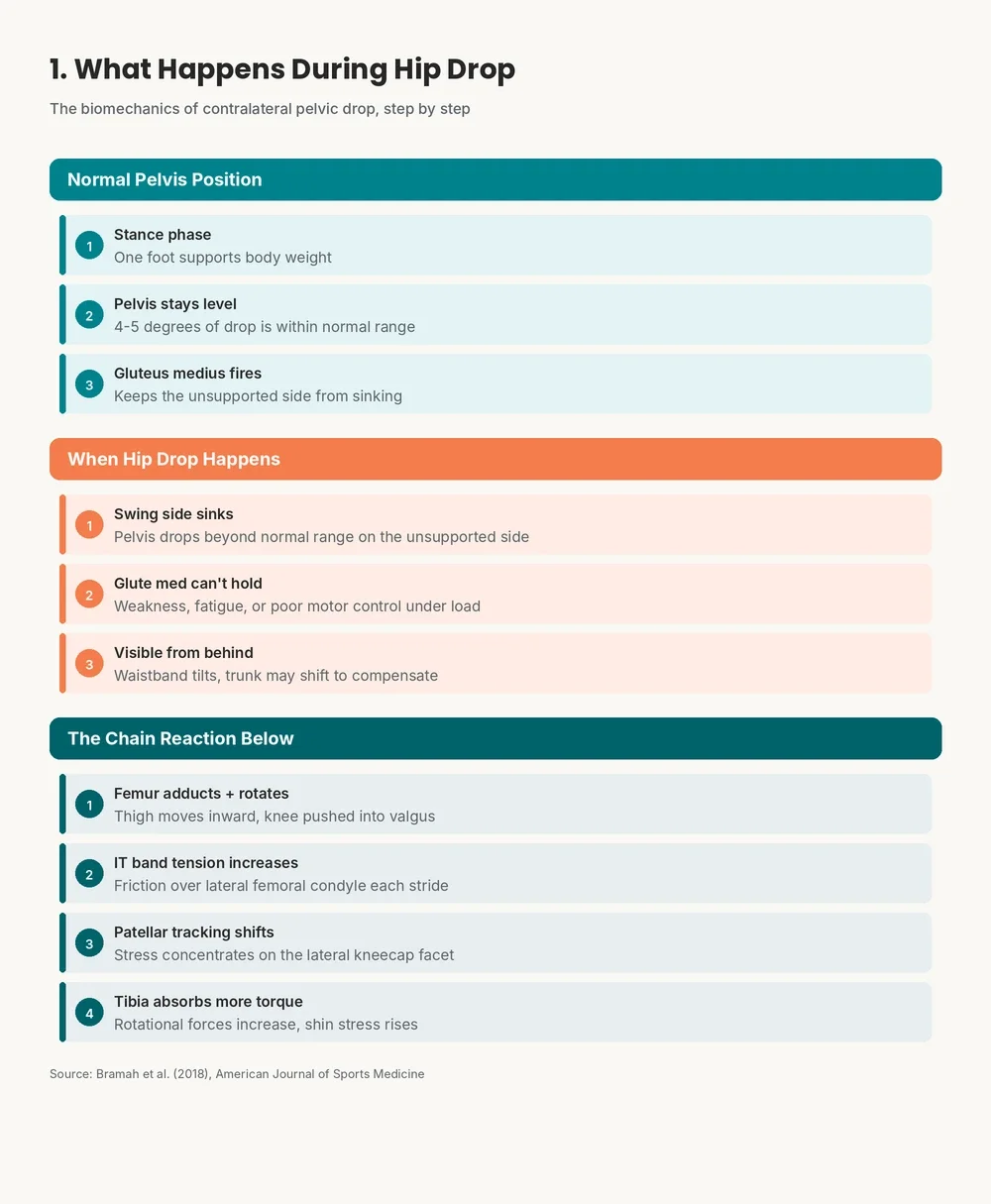
The gluteus medius sits on the outer surface of the hip, fanning out from the iliac crest to the greater trochanter of the femur. Its primary job during running is to keep the pelvis level during single-leg stance, which accounts for about 80 percent of each stride cycle. When the glute med fires properly, the pelvis stays close to level and the entire kinetic chain from trunk to foot stays aligned. When it doesn't fire hard enough or fast enough, gravity wins and the unsupported side drops.
It's Not Just Weakness
Here's something worth knowing: plenty of runners have adequate glute medius strength when tested in isolation on a treatment table but still show excessive hip drop when they run. That disconnect happens because running demands rapid, coordinated muscle activation under load and fatigue, not just raw strength. Your glute med might test fine at mile one and fail at mile eight. Fatigue-related hip drop is one of the most common patterns identified in gait analysis, and it's why a static strength test alone doesn't tell the whole story.
Other Contributing Factors
Several things can amplify hip drop beyond simple gluteus medius capacity. Core stability plays a role because the trunk and pelvis work as a unit, and a core that can't resist rotation lets the pelvis move more freely. Ankle stiffness or weakness can change ground reaction forces in ways that increase demands on the hip. Training errors like a sudden jump in mileage or intensity also expose weaknesses that were borderline under lighter loads.
What the Research Says About Hip Drop and Injury
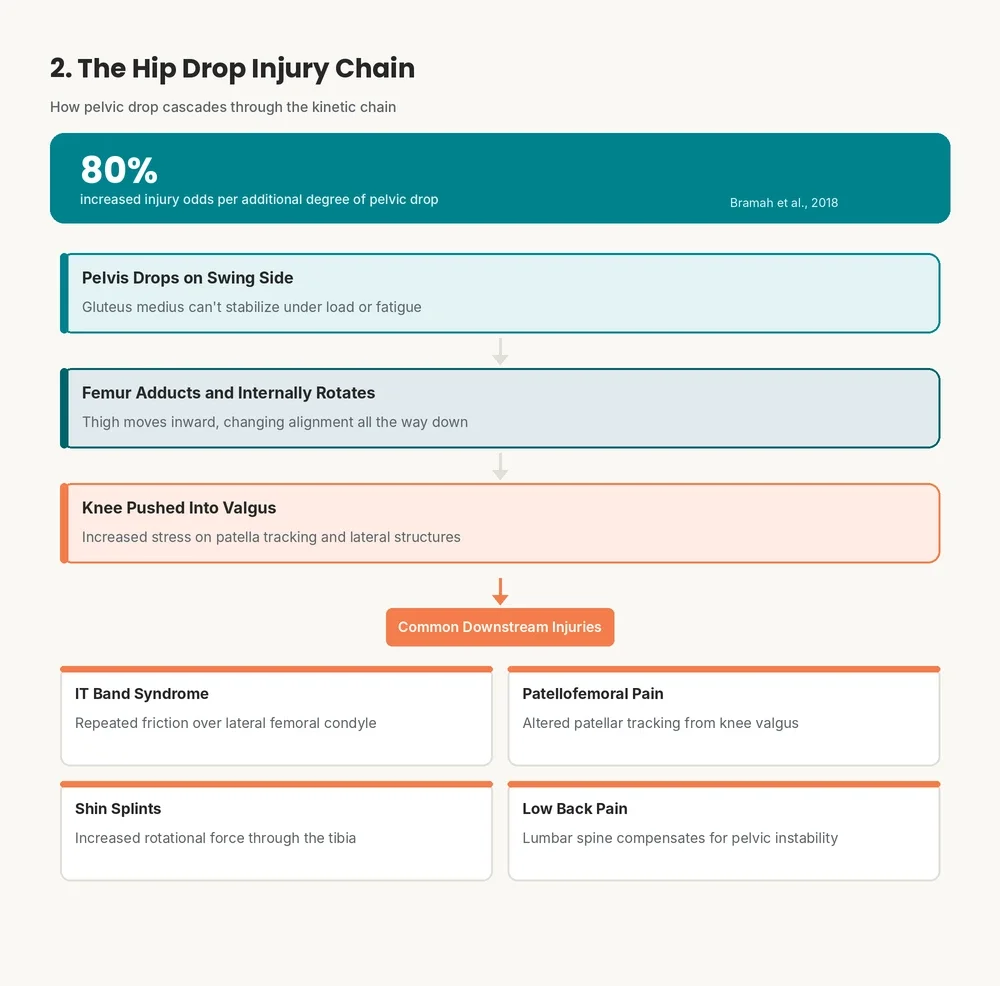
The most-cited study comes from Bramah et al. (2018), published in the American Journal of Sports Medicine. They compared 72 runners with overuse injuries to 36 healthy controls using 3D motion capture. Contralateral pelvic drop was one of the strongest predictors of injury status, with each additional degree above the healthy average raising the odds of being in the injured group by roughly 80 percent.
A separate study by Dingenen et al. (2019) with 42 runners found greater pelvic drop in those who developed injuries, supporting the same pattern. These findings don't prove hip drop causes injury on its own, but they consistently show up as part of the biomechanical profile that distinguishes injured runners from uninjured ones.
The Injury Chain Below the Hip
When the pelvis drops excessively on one side, the stance leg has to compensate. The femur tends to adduct and internally rotate, pushing the knee into a valgus position. That chain of movement stresses several structures at once.
IT band syndrome is one of the most common consequences. The increased hip adduction and internal rotation from pelvic drop tightens the IT band over the lateral femoral condyle, creating friction with every stride.
Patellofemoral pain follows a similar path. The knee valgus that results from pelvic drop changes patellar tracking, concentrating stress on the lateral facet of the kneecap.
Shin splints and tibial stress can also trace upstream to hip drop. When the pelvis doesn't stay stable, the tibia absorbs more rotational force than it should.
Low back pain appears on the opposite end of the chain. Excessive pelvic motion forces the lumbar spine to compensate, often through lateral flexion or rotation, adding load to structures that prefer stability.
How Gait Analysis Measures Hip Drop
A running-focused gait analysis captures pelvic drop with slow-motion video recorded from behind during treadmill running. The clinician places markers or uses visual landmarks to measure how many degrees the pelvis tilts during the stance phase of each leg. That measurement gets compared between sides because asymmetry matters as much as the raw number.
What the Numbers Tell You
Most research defines "normal" contralateral pelvic drop as somewhere around 4 to 5 degrees. The injured runners in the Bramah study showed values significantly above the healthy group's average, with the relationship between hip drop and injury risk following a dose-response pattern: the more drop, the higher the odds.
But context matters. A 6-degree drop in a runner covering 20 miles a week at an easy pace carries different implications than the same measurement in someone training for a marathon with weekly track sessions. That's why a gait analysis at The Runner's Mechanic doesn't just hand you a number. It looks at pelvic drop alongside cadence, foot strike, trunk lean, ground contact time, and vertical oscillation, then connects those findings to your injury history, training load, and goals.
Asymmetry as a Warning Sign
One-sided hip drop is especially informative. If your pelvis drops more on the left during right-leg stance, that tells the clinician your right hip abductors need specific attention. Bilateral hip drop with more on one side often points to a combination of general hip weakness and a side-specific deficit, which changes the rehab approach.
Fixing Hip Drop Without Overcomplicating It
Correcting hip drop comes down to two things: building the capacity of the hip stabilizers and teaching the nervous system to use that capacity during running. Both need to happen because strength without motor control doesn't transfer to the road.
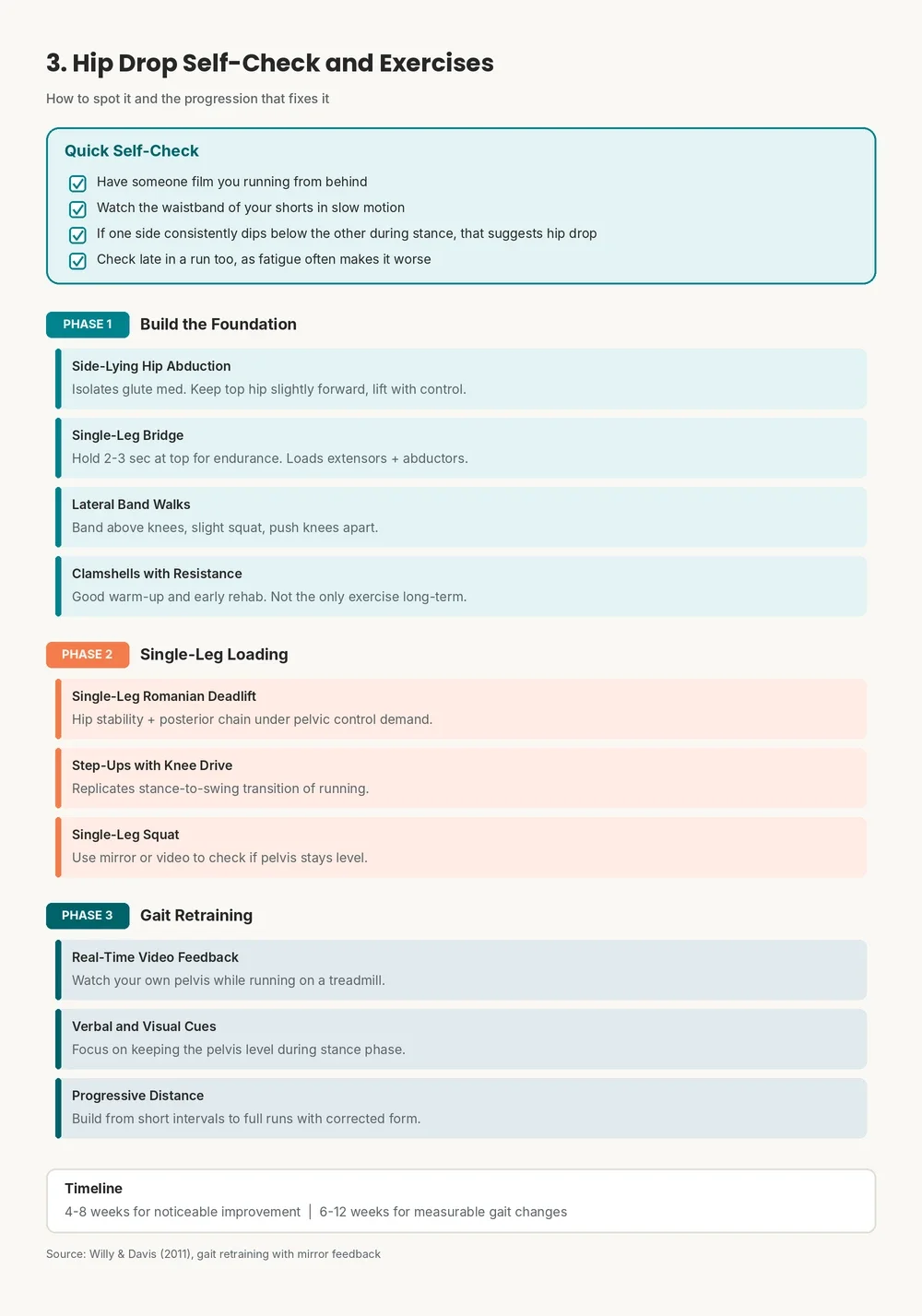
Phase 1 - Build the Foundation
Start with exercises that isolate and load the gluteus medius and hip abductors in positions that mimic the demands of running.
Side-lying hip abduction targets the glute med without compensation. Keep the top hip slightly forward and lift with control. The movement is smaller than most people expect.
Single-leg bridge loads the hip extensors and abductors together. Hold at the top for 2 to 3 seconds to build endurance, not just peak strength.
Lateral band walks train the glute med in a functional standing position. Keep the band above the knees, maintain a slight squat, and push the knees apart rather than just stepping sideways.
Clamshells with resistance work at lower loads and are useful early in rehab or as part of a warm-up, though they shouldn't be the only exercise long-term.
Phase 2 - Load in Single-Leg Positions
Running is a single-leg activity, so your hip strengthening needs to progress to single-leg loading.
Single-leg Romanian deadlift challenges hip stability and posterior chain strength while demanding pelvic control.
Step-ups with knee drive replicate the stance-to-swing transition of running and build power in the glute med under bodyweight load.
Single-leg squat with pelvic control cues teaches the hip to stabilize while the knee bends under load. A mirror or video helps you see whether your pelvis stays level.
Phase 3 - Gait Retraining
Strength work alone doesn't always change running mechanics. Gait retraining uses real-time visual or verbal cues during treadmill running to help you adopt a more level pelvis. At The Runner's Mechanic, this happens with live video feedback so you can watch your own pelvis while you run and correct the drop in real time.
Research supports this approach. A study by Willy and Davis (2011) showed that mirror-based gait retraining reduced hip adduction and contralateral pelvic drop in female runners, and the improvements held at a one-month follow-up without the mirror.
When Hip Drop Might Not Be the Real Problem
Not every runner with visible hip drop needs to fix it. A few degrees of pelvic movement is normal and might actually serve as a shock-absorption strategy. The decision to intervene depends on whether the hip drop is associated with symptoms, whether it's getting worse with fatigue, and whether the degree falls within or outside the ranges linked to injury risk in the research.
Sometimes what looks like hip drop is actually driven by something else entirely. A stiff ankle on one side can force more pelvic compensation. A leg-length difference can create asymmetric drop that mimics hip weakness. A trunk lean pattern can make pelvic drop appear worse than it is. That's why a comprehensive evaluation that looks at the whole chain is more useful than focusing on one measurement.
Frequently Asked Questions
How do I know if I have hip drop?
The easiest self-check is to have someone record you running from behind on a phone. Look at the waistband of your shorts, and if one side consistently dips below the other during stance phase, that suggests pelvic drop. A more reliable assessment uses slow-motion video with angle measurements, which is what a clinical gait analysis provides.
Can hip drop cause knee pain?
Yes. When the pelvis drops, the stance-leg femur tends to move inward, changing the angle at the knee. That shift can stress the patella, the IT band, and the medial structures of the knee. Research consistently links excessive pelvic drop to patellofemoral pain and IT band syndrome in runners.
How long does it take to fix hip drop?
Most runners start noticing improvements in 4 to 8 weeks of consistent strengthening and motor control work. Measurable changes in pelvic drop during running usually take 6 to 12 weeks because motor patterns need time to change under fatigue. Some runners need gait retraining on top of strengthening to see the changes transfer to their actual running mechanics.
Does hip drop get worse with distance?
Often, yes. Many runners maintain reasonable pelvic control early in a run, but as the hip abductors fatigue, the drop increases. This is one reason some running injuries only show up beyond a certain mileage threshold, and why gait analysis at different points in a run can reveal problems a short test might miss.
Should I stop running if I have hip drop?
Usually not. Unless the drop is causing acute pain or an injury that requires rest, most runners can continue training while working on the underlying strength and control issues. Adjusting intensity, volume, and terrain can reduce the load on compensating structures while you build capacity. A running physical therapy evaluation helps determine the right balance.
Is hip drop the same as a Trendelenburg gait?
They're closely related. A Trendelenburg gait is the clinical term for the walking or running pattern that results from hip abductor insufficiency, where the pelvis drops on the unsupported side. Hip drop during running is essentially a dynamic Trendelenburg sign that shows up under the specific demands of running speed and fatigue.
TL;DR
Contralateral pelvic drop during running, often called hip drop, is one of the most common gait faults identified in injured runners. The pelvis sinks on the swing-leg side because the stance-leg gluteus medius isn't generating enough force or activating quickly enough to keep things level. Research links each additional degree of drop to a meaningful increase in injury risk, with downstream effects on the knee, IT band, shin, and lower back. Fixing it requires a progressive approach that combines targeted hip strengthening with single-leg loading and, often, gait retraining with real-time feedback. The pattern frequently worsens with fatigue, so testing at multiple points during a run gives the clearest picture. Getting a baseline measurement through a professional gait analysis tells you exactly where you stand and what needs to change.

Run pain-free, run longer
Frame-by-frame gait analysis, hands-on treatment, and a plan built around the mechanics of your stride, all in one Asheville visit.
Whether you've been chasing a stubborn IT band issue, dealing with recurring knee pain that flares after longer runs, or just noticed that your form falls apart past a certain mileage, a running-focused evaluation at The Runner's Mechanic puts pelvic drop in context with everything else happening in your stride. Miriam Salloum uses frame-by-frame video analysis, strength and movement testing, and hands-on treatment to build a plan around your specific mechanics. Book your evaluation or call 828-713-0929 to get started.