

Crossover Gait: What a Crossover Gait Actually Looks Like
TL;DR
Crossover gait happens when your feet land on or across an imaginary line down the middle of your body during running, instead of landing in two parallel lanes. It traces back to a narrow step width that increases stress on the IT band, knee, and lower leg. Research by Meardon and Derrick (2014) linked a narrower step width to higher tibial stress, with the opposite shift reducing those loads measurably. The fix is rarely a strength issue in isolation. It usually comes down to a coordinated cueing approach combined with hip abductor work. A running-focused evaluation at The Runner's Mechanic in Asheville measures step width directly so you know whether a crossover pattern is contributing to your symptoms.
What a Crossover Gait Actually Looks Like
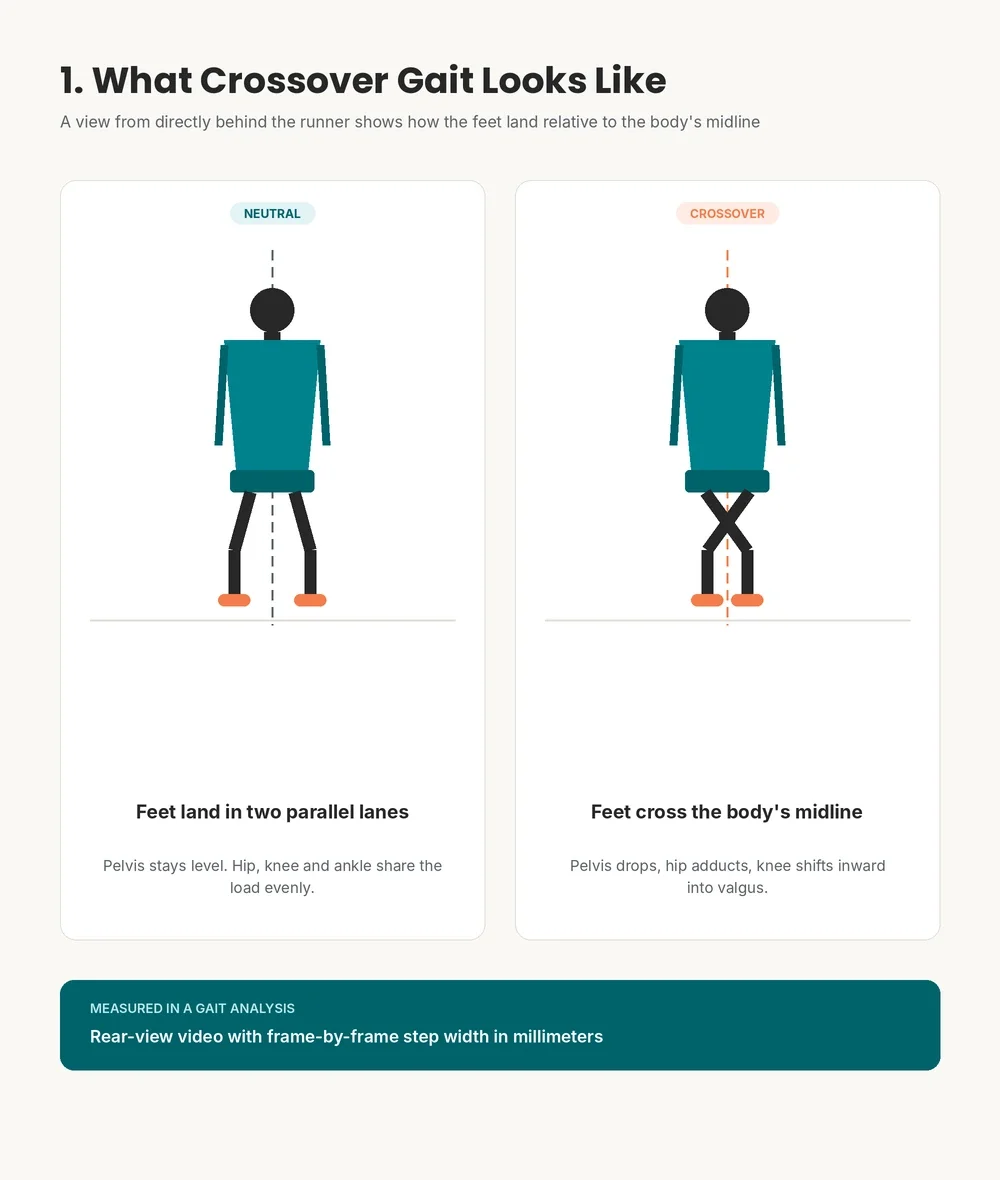
From behind, a runner with a crossover gait looks like they are running on a tightrope. Each foot lands on, or just past, an invisible line drawn between the two feet. In a neutral running pattern, the feet land in two separate lanes with a small gap between them, somewhere between hip width and a few inches apart. In a crossover pattern, the lanes overlap or cross entirely.
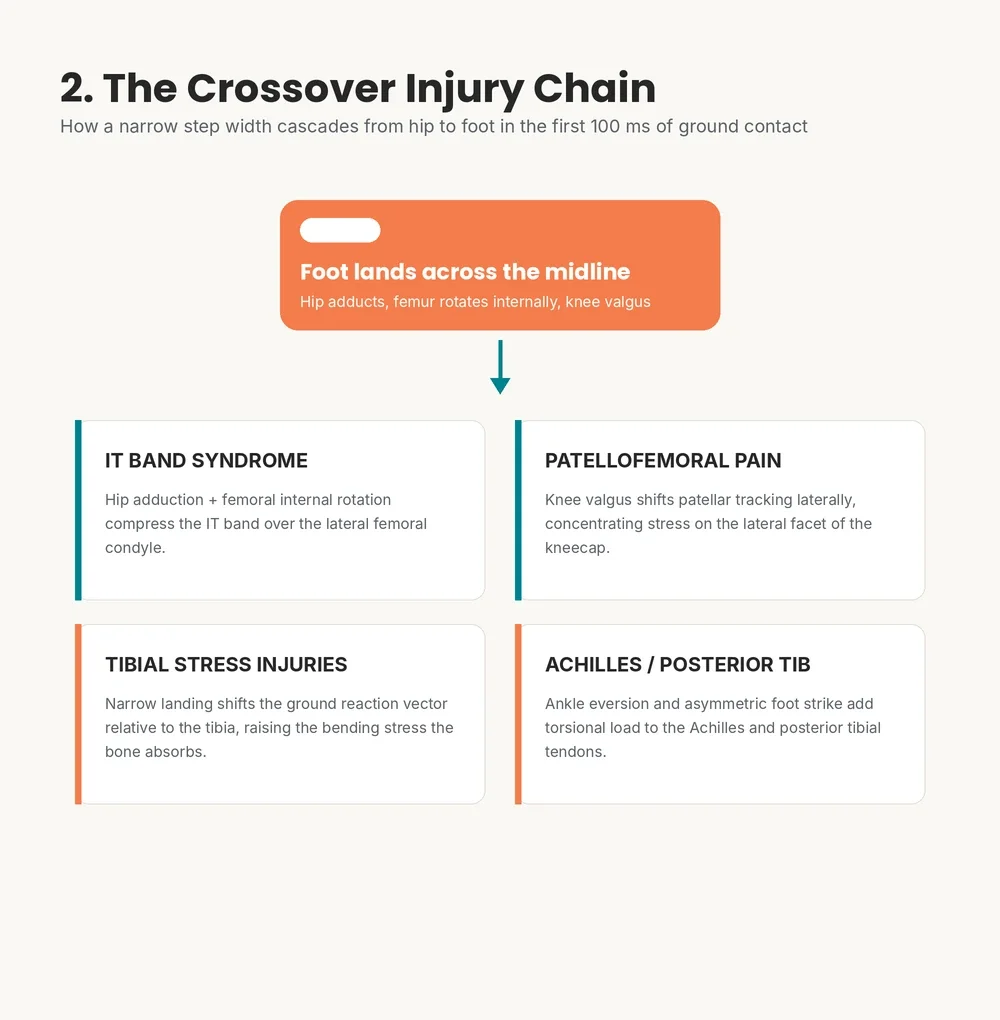
The visual gives the clearest clue, but the mechanical consequences are what matter. When the foot lands inside the body's midline, the pelvis has to drop toward the swing leg to allow the stance leg to clear, the hip adducts and internally rotates, and the knee shifts toward a valgus angle. All of that happens in the first hundred milliseconds of ground contact, repeated thousands of times per run.
Severity exists on a spectrum. Some runners show a mild narrowing where the feet still land in separate lanes but closer together than they should. Others show a true crossover where the right foot plants to the left of the body's centerline and the left foot plants to the right of it. The more severe the crossover, the larger the mechanical consequences that follow, and the higher the injury risk the research has identified.
At The Runner's Mechanic in Asheville, a running-focused evaluation includes a slow-motion video from directly behind the treadmill so step width and foot landing position can be measured, not estimated. Miriam Salloum, MPT, uses frame-by-frame playback to quantify how far across the midline each foot is landing and whether the pattern is symmetrical or one-sided.
Why Runners Develop a Crossover Gait
Crossover gait is almost never a conscious choice. It develops over time, usually from a mix of biomechanical and training factors that reinforce a narrower step width than the body can handle.
Hip Abductor Capacity
The gluteus medius and tensor fasciae latae stabilize the pelvis in the frontal plane. When those muscles don't produce enough force or activate quickly enough, the pelvis tilts toward the swing leg, which pulls the stance foot inward across the body's midline. Many runners with crossover gait show adequate strength on a treatment table but lose that control under the repetitive demands of running. The underlying deficit is identical to what drives contralateral pelvic drop, which is why the two patterns so often appear together in the same runner.
Trunk Lean and Posture
Running with a forward trunk lean from the hips (rather than a slight forward lean from the ankles) changes how the pelvis moves and often pulls the feet closer together. A runner who leans to one side, intentionally or not, shifts their center of mass over the planted foot, which can create or worsen a crossover pattern on that side. Arm swing plays a secondary role here. A runner whose arms cross their chest rather than swinging forward and back generates rotational torque through the trunk, and that rotation often shows up at the feet as a narrow or crossing landing.
Habit and Surface
Running primarily on a crowned road, a narrow trail, or a treadmill belt with limited width can nudge the step narrower over time until it feels natural. Runners who focus on a quick turnover without thinking about where the feet land often default to a narrower pattern because it feels more efficient, even when it isn't. Shoe choice can play a minor role as well. Shoes with aggressive lateral stability posts can mask a crossover pattern by physically preventing some of the ankle motion that would otherwise be visible, which means the pattern gets missed at the running store but still shows up in the injury pattern.
What the Research Says About Crossover Gait and Injury
The best-known study on step width in runners comes from Meardon and Derrick (2014), who manipulated step width in a controlled lab setting and measured how peak tibial stress changed. Narrowing step width increased tibial stress, and widening step width reduced it. The relationship was consistent across the runners in the sample. A separate line of work from Brindle, Willson, and colleagues has linked narrower step width to higher peak hip adduction and higher knee abduction moments, both of which are mechanical patterns associated with lower-limb injury.
A 2010 study by Pohl and colleagues followed runners prospectively and found that those who developed IT band syndrome ran with greater peak hip adduction and greater knee internal rotation than runners who stayed healthy. A crossover gait amplifies both. These findings don't mean every runner with a narrow step width will get injured, but they consistently appear in the injury-risk profiles pulled from biomechanics labs that specialize in running gait analysis.
The dose-response relationship matters. The runners with the most extreme step narrowing in these studies showed the largest mechanical changes, and researchers have replicated the pattern across different populations of runners. The take-home is not that crossover gait is always bad but that it's a measurable mechanical variable that scales with injury risk, which makes it a useful target to measure and address.
The Injury Chain From a Crossover Pattern
When each foot lands across the body's midline, the loading pattern through the hip, knee, and lower leg changes in predictable ways. The cascade below shows up repeatedly in injured runners during behind-view analysis.
IT band syndrome is the most frequently discussed consequence. The combined hip adduction and femoral internal rotation that follow a crossover footstrike compress the IT band against the lateral femoral condyle, which is the classic mechanical story behind that pain. Runners who get a diagnosis of IT band syndrome often have been treating the band itself with foam rolling and stretching, but the mechanical trigger, the crossover pattern, keeps re-creating the problem until the step width changes.
Tibial stress injuries, including medial tibial stress syndrome and tibial stress fractures, show up because the narrow landing shifts the ground reaction force vector relative to the tibia, increasing the bending stress the bone absorbs. This is the specific mechanism Meardon's work documented. Shin pain that appears during a training block ramp-up, especially one with new mileage or new terrain, is a signal worth checking against step-width measurements.
Patellofemoral pain commonly follows the knee valgus that a crossover gait creates. The patella tracks laterally against the trochlear groove, concentrating stress on the lateral facet of the kneecap. Female runners show patellofemoral pain at higher rates in the research, partly because the Q-angle of the hip predisposes some runners to more knee valgus to begin with, and a crossover gait sits on top of that pre-existing tendency.
Achilles and posterior tibial tendon problems appear less often but do show up, particularly in runners whose crossover pattern is combined with excessive ankle eversion or a hard forefoot strike. The rotational component of a crossover landing twists the foot and ankle in ways that add shear load to both tendons across the thousands of steps in a long run.
How Gait Analysis Spots a Crossover Gait
A running-focused evaluation captures step width from a rear-view camera during treadmill running at the runner's typical training paces. Markers or visual landmarks on the heels let the clinician measure the distance between foot landings and determine whether the pattern is symmetrical or one-sided. The measurement gets cross-referenced with pelvic drop, trunk lean, and hip rotation so the full mechanism, not just the symptom, becomes visible. This is the core of what a gait analysis shows for a runner carrying a stubborn or recurring injury pattern.
What the Measurements Actually Tell You
A step width close to zero, or one where the feet actively cross the midline, signals a crossover pattern. A very wide step width can also carry costs, so the goal is rarely "as wide as possible" but a step width that reduces hip adduction and keeps the knees tracking cleanly over the feet. Most research references a healthy range that corresponds to the runner's own pelvis width, which varies between runners and can't be pulled from a generic table.
Asymmetry carries its own information. A runner whose right foot crosses the midline while the left stays neutral usually has a left-side hip stability deficit rather than a right-side problem, because the left stance phase is where the breakdown is happening. Treating only the symptomatic right leg misses the actual mechanical driver. This is one of the most common blind spots in self-directed rehab and why objective measurement beats visual guesses from a training partner.
Testing at different points during a run adds depth to the measurement. A runner whose step width looks fine at mile one but collapses toward the midline by mile six has a fatigue-driven crossover, which is a different problem than a runner whose crossover appears from the first stride. The intervention differs too. Fatigue-driven crossover usually needs more endurance-focused hip work, while a steady-state crossover typically needs heavier cueing early in the retraining process.
How Crossover Gait Relates to Other Gait Faults
Crossover gait rarely appears alone. The same underlying hip stability deficit that drives a narrow step width usually produces other patterns alongside it, and the full picture matters more than any single finding.
Contralateral pelvic drop often sits one layer down from a crossover pattern. When the glute med can't hold the pelvis level, the pelvis tips toward the swing leg and the stance foot gets pulled inward across the midline. Fixing one usually helps the other, which is why a comprehensive rehab plan treats them together rather than chasing them separately.
Over-striding, where the foot lands too far in front of the body's center of mass, often shows up alongside a crossover gait. Both patterns tend to appear in runners who have cadence rates below the 170-to-180 steps-per-minute range that most research associates with efficient running mechanics. A cadence adjustment can indirectly shorten the stride and widen the step at the same time because faster turnover makes the narrow, over-striding pattern harder to maintain.
Trunk rotation, where the shoulders twist excessively side-to-side during running, is a third commonly linked pattern. The rotational force travels down through the pelvis and often shows up as a crossover landing on whichever side the rotation is more pronounced. Addressing trunk control through core stability work often reduces the rotation and the crossover at the same time.
Fixing a Crossover Gait Without Overcomplicating It
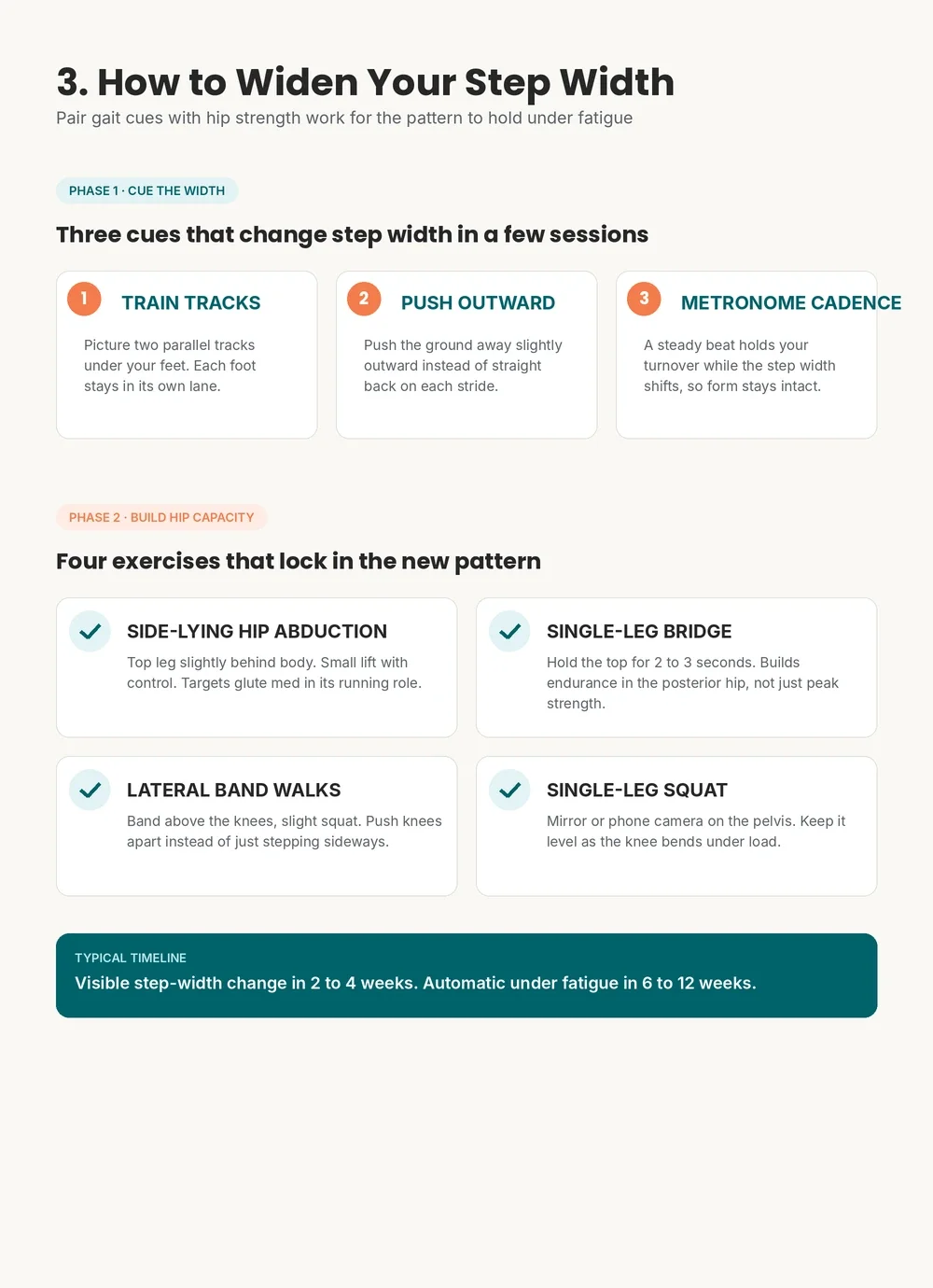
The two most effective interventions for a crossover gait are gait cueing and targeted hip strengthening. One alone rarely delivers lasting change. Done together, most runners can shift their step width within a few weeks and see the new pattern carry into their everyday running.
Phase 1 - Cue the Width
Gait retraining works. Research by Willy, Davis, and colleagues on related patterns has shown that simple, consistent cues delivered during treadmill running can change step width meaningfully in as little as a few sessions, with retention weeks later. The treadmill portion of a running physical therapy evaluation at The Runner's Mechanic builds these cues in live so the runner can see and feel the correction in real time rather than just hearing about it after the session.
The two cues that work best for most runners are imagining two parallel train tracks under the feet and focusing on pushing the ground away slightly outward rather than straight back. A metronome helps some runners by stabilizing cadence while the step width shifts. External focus cues (something the runner pictures in the environment around them) tend to stick better than internal focus cues (something the runner feels in their own body), which is why the train-tracks image outperforms a cue like "activate your glutes" in most clinical settings.
Phase 2 - Build the Hip Capacity
Cueing a wider step width without the hip abductor capacity to maintain it means the pattern collapses once the runner stops thinking about it. The strength work doesn't need to be exotic.
Side-lying hip abduction with the top leg slightly behind the body targets the gluteus medius in a position close to its role during running. Single-leg bridges hold the pelvis level under load and build endurance in the posterior hip. Lateral band walks train the glute med in a functional standing position when done with a slight squat and the knees pushed apart. Single-leg squats with a cue to keep the pelvis level translate the capacity to a loaded single-leg position, which is what running actually demands.
Progression matters more than variety. Running the same four exercises with gradually increased load, hold times, or repetitions builds the specific tissue adaptations that let the hip hold the new step width through a full training run. Swapping exercises every week feels productive but often slows the capacity gains that make the gait change stick.
Phase 3 - Maintain and Monitor
Once the new step width is established, the main risk is that fatigue late in a longer run pulls the pattern back toward the old crossover. Keeping up the hip strengthening two or three times a week through the training block, plus an occasional check-in with the step-width cue on easier runs, keeps the change durable. A follow-up evaluation at six to twelve weeks confirms that the pattern has held under running conditions, not just in the exercise room.
When a Narrow Step Width Might Not Be the Real Problem
Not every runner with a visible crossover gait needs to change it, and not every injury that looks like a crossover problem actually is one. Some runners run comfortably and durably with a step width that measures narrower than the research norms, particularly if their hip stability is strong enough to hold the pelvis level.
A crossover pattern that only appears late in a run usually points to fatigue in the hip abductors rather than a structural issue. A one-sided crossover often reflects a specific leg-length or ankle-mobility asymmetry that needs its own assessment. A crossover pattern combined with a very forward trunk lean sometimes resolves on its own when the trunk position is corrected, because the center of mass shifts and the feet track underneath the hips naturally.
That's why the full behind-view picture matters more than any single camera angle. The step width measurement tells you one thing, but hip strength, trunk control, and the runner's symptoms together tell you whether it's the right thing to work on.
Frequently Asked Questions
How do I know if I have a crossover gait?
Have someone record you running from behind on a phone. Look at where each foot lands relative to an imaginary line between them. If the feet land on or across that line, you have some degree of crossover. A clinical measurement quantifies it in millimeters so the baseline is objective instead of a guess.
Does crossover gait always cause injury?
No. Research shows it increases mechanical loading on structures that commonly get injured in runners, but plenty of runners run a narrow step width without symptoms. The pattern matters most when it shows up alongside pain, a recent change in training load, or a recurring injury.
How quickly can I fix a crossover gait?
Most runners see visible step-width changes within two to four weeks of consistent cueing and strength work. The pattern becoming automatic under fatigue usually takes six to twelve weeks because motor patterns need repetition under load to rewire.
Can I just focus on step width without changing anything else?
Cueing a wider step width without the hip strength to hold it is the single most common reason crossover retraining fails. The capacity has to come with the cue, or the pattern reverts the moment the runner stops thinking about it.
Will a wider step width slow me down?
A moderate widening to a neutral step width hasn't been shown to slow runners down in the research, and most runners report that the new pattern feels more stable once it becomes habitual. Overcorrecting to a very wide step width can create its own problems, which is why a measured target from a clinical evaluation works better than guessing.
Is crossover gait the same as overpronation?
They're different patterns that can overlap. Overpronation refers to how the foot rolls inward after landing. Crossover gait refers to where the foot lands relative to the body's midline. A runner can have one without the other, or both at once, and the interventions are different for each.
Can new shoes fix a crossover gait?
Shoes can change how the foot rolls after landing, but they can't change where the foot lands relative to the body's midline. That's a mechanical pattern driven from the hip down, not from the shoe up. A runner who switches shoes to address a crossover gait usually sees the pattern return once the novelty of the new shoe wears off, because the underlying hip control hasn't changed.
Does cadence matter for crossover gait?
Yes, indirectly. A higher cadence shortens the time each foot is in the air and often naturally widens the step width because the runner has less time to swing the leg across the body's midline. Research has associated cadences in the 170-to-180 steps-per-minute range with cleaner running mechanics, and a cadence adjustment is one of the simpler cues that can reduce a mild crossover pattern.
TL;DR
Crossover gait, the pattern where the feet land on or across an imaginary centerline during running, shifts loading through the hip, knee, and lower leg in ways that research links to IT band syndrome, patellofemoral pain, and tibial stress injuries. The mechanism combines a narrower-than-optimal step width with hip adduction, femoral internal rotation, and knee valgus, all appearing within the first hundred milliseconds of ground contact. Fixing it comes down to two coordinated moves. First, retrain the step width with simple cues during treadmill running. Second, build the hip abductor capacity to hold the new pattern under fatigue. Most runners shift the pattern within a few weeks and lock it in over a few months of consistent work.
Whether you've been dealing with a stubborn IT band flare, recurring tibial stress symptoms, or a knee that only hurts after a certain mileage, a running-focused evaluation at The Runner's Mechanic puts step width in context with the rest of your running mechanics. Miriam Salloum uses frame-by-frame video analysis, strength and movement testing, and hands-on treatment to build a plan around what your stride is actually doing. Book your evaluation or call 828-713-0929 to get started.

Run pain-free, run longer
Frame-by-frame gait analysis, hands-on treatment, and a plan built around the mechanics of your stride, all in one Asheville visit.