
Knees Caving In When Running
TL;DR
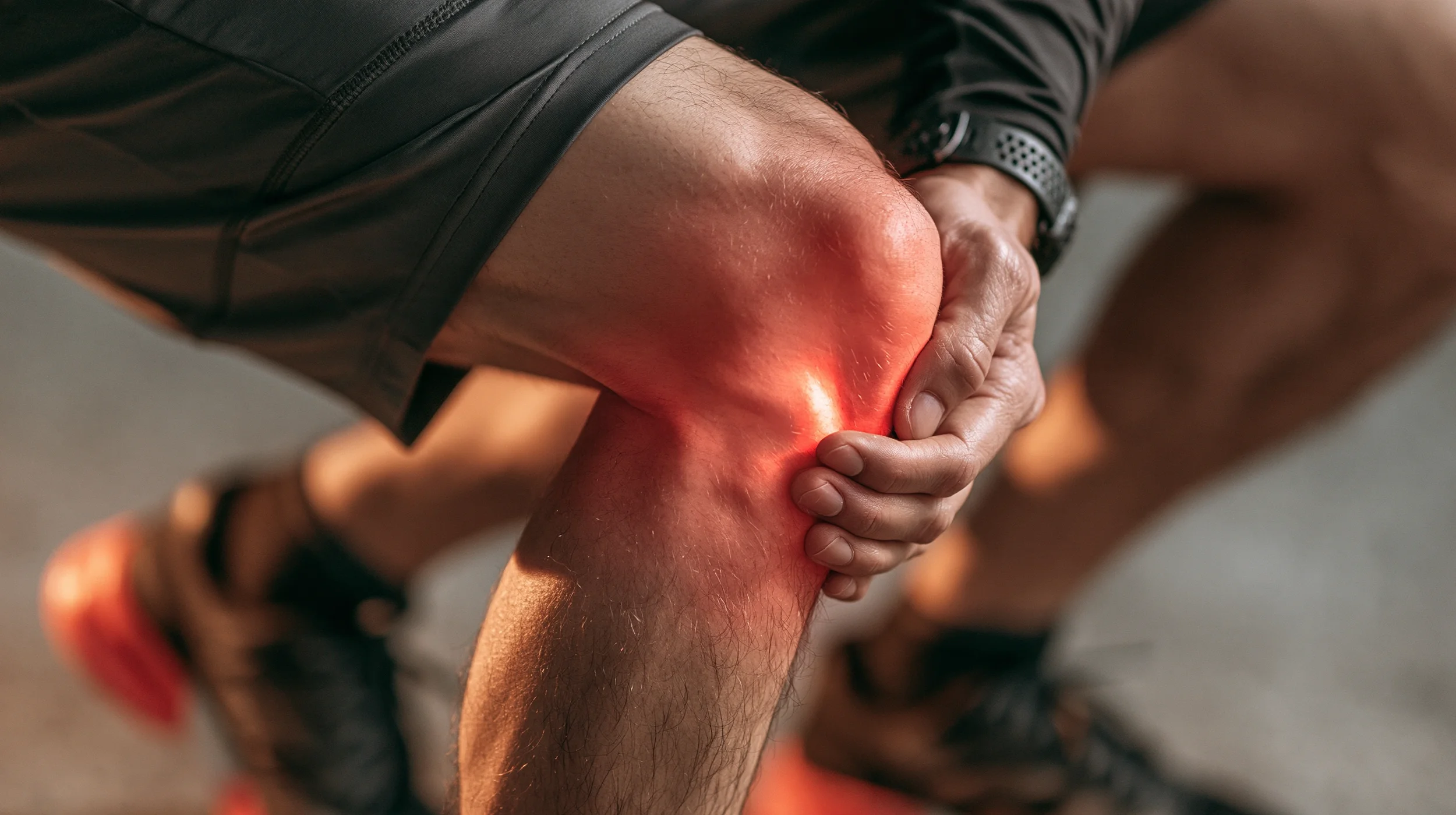
When your knees cave inward during each running stride, you're seeing dynamic knee valgus. The knee drifts toward the body's midline instead of tracking cleanly over the foot, usually because the hip abductors can't hold the femur in place under single-leg load. Research links this pattern to patellofemoral pain, IT band syndrome, and higher strain through the medial knee structures. The fix combines hip strengthening with movement retraining, and most runners can shift the pattern meaningfully in six to twelve weeks. A running-focused evaluation at The Runner's Mechanic in Asheville measures knee valgus directly from a front-view camera so the retraining plan targets real numbers.
What Knees Caving In Actually Looks Like
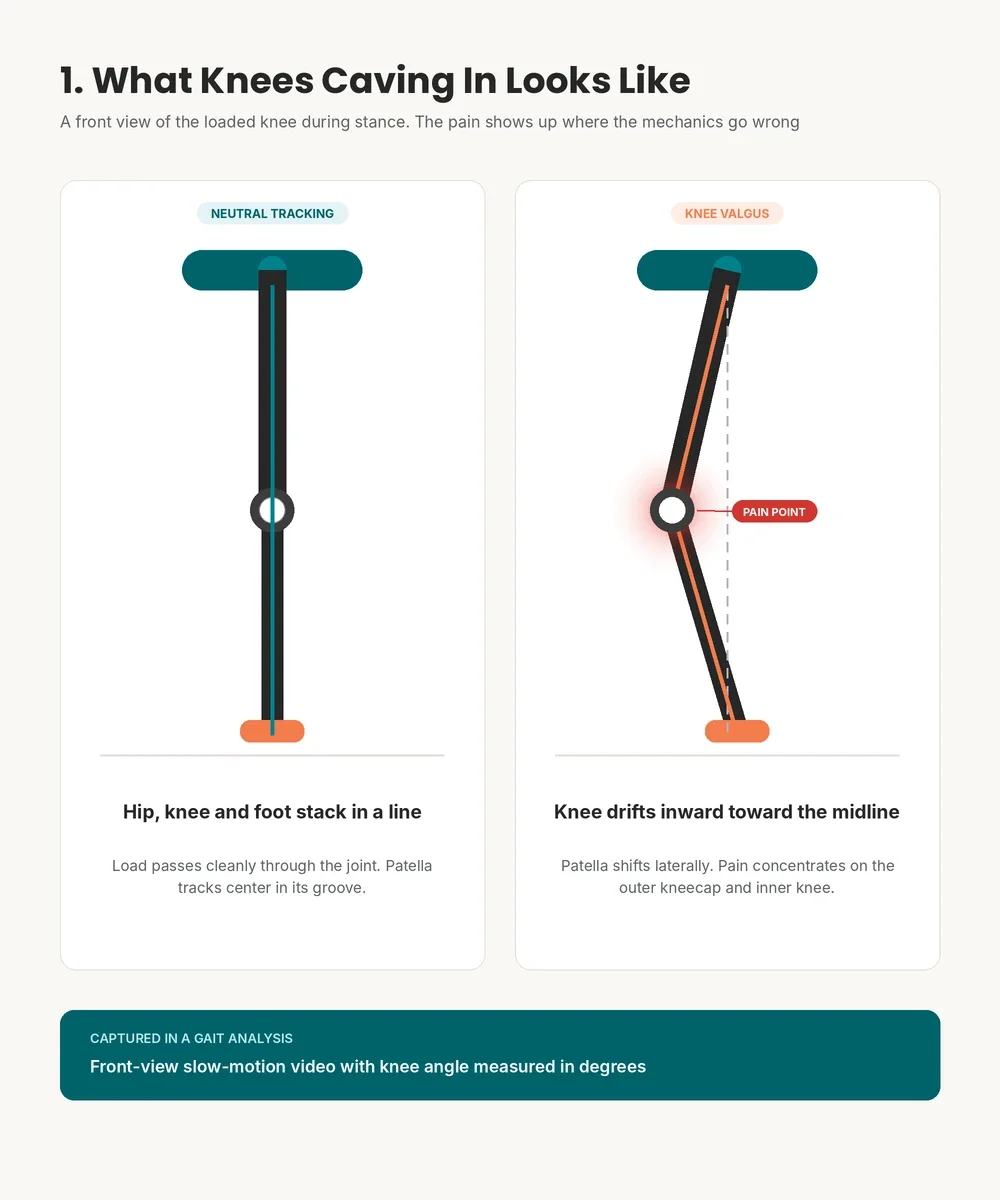
From the front, a runner with knee valgus looks like each knee rolls inward every time the foot lands. In a neutral running pattern, the hip, knee, and foot stack in a straight vertical line during the stance phase. The knee bends but stays directly over the second toe. With dynamic knee valgus, that line breaks at the knee. The femur rotates inward, the tibia rotates outward, and the knee ends up medial to where the foot plants.
The severity varies. Some runners show a subtle inward drift of five to ten degrees that only appears in slow-motion video. Others show a dramatic collapse where the knees nearly touch on every stride. The research consistently links larger valgus angles to higher injury rates, and the pattern tends to worsen as fatigue sets in late in a run.
What makes knee valgus tricky to spot in real time is that it happens in the first hundred milliseconds of ground contact. By the time the runner feels anything, the loading cycle has already repeated thousands of times. Miriam Salloum, MPT, uses frame-by-frame playback during a running-focused evaluation to measure the actual knee angle at footstrike and at mid-stance, then compares both sides for asymmetry.
Why Runners' Knees Cave In
Knee valgus during running is almost always driven from above or below the knee, rarely by the knee itself. Three main contributors show up in the research and in the clinic.
Hip Abductor Weakness
The gluteus medius and gluteus minimus stabilize the femur in the frontal plane during single-leg stance. When those muscles can't hold the hip against gravity, the femur adducts and internally rotates, and the knee follows it inward. Work by Ferber, Powers, and others has repeatedly shown that runners with knee valgus and runners with patellofemoral pain test weaker in hip abduction and external rotation than healthy controls, with strengthening studies showing symptom improvement when the hip measurements improve.
Foot and Ankle Mechanics
The foot carries about half the story. Excessive pronation after footstrike rotates the tibia inward, which pulls the knee medially through the kinetic chain. A stiff ankle that can't dorsiflex well during stance forces the knee to compensate inward to keep the body moving forward. Runners with either pattern often develop knee valgus even when their hip strength tests fine, because the drive comes from the ground up rather than the hip down.
Trunk Control and Deceleration
The trunk and core play a quieter but important role. A runner whose core can't resist rotation under single-leg impact lets the pelvis tip, which pulls the femur with it. The same pattern that produces pelvic drop often produces knee valgus on the same stride, because both are downstream of the same stability deficit. Runners who struggle to decelerate their body weight on landing, especially downhill or at the end of a long run, show the biggest valgus increase as fatigue sets in.
What the Research Says About Knee Valgus and Injury
The knee valgus research in runners is deep. Studies by Noehren, Davis, and colleagues following female runners prospectively found that those who developed patellofemoral pain ran with higher peak hip adduction and higher peak hip internal rotation than runners who stayed healthy. Those two variables sit directly upstream of dynamic knee valgus. Powers (2010) laid out the biomechanical model showing how the femur rotating under a planted foot produces the inward knee collapse, and how that collapse concentrates patellofemoral joint stress on the lateral facet of the kneecap.
Separate research on the ACL side comes from cutting sports rather than distance running, but the mechanical pattern is the same. The combination of hip adduction, femoral internal rotation, and tibial external rotation that produces knee valgus is the exact loading pattern the research links to ACL strain. Distance runners don't tend to tear ACLs mid-run, but the same forces that threaten the ligament in a cutting athlete load it through every stride in a runner with significant valgus, which matters most on downhills and uneven terrain.
Hip-strengthening programs have been studied extensively. Khayambashi and colleagues showed that an eight-week hip abductor and external rotator program reduced patellofemoral pain and improved function, with the gains maintained at six-month follow-up. More recent work on gait retraining has shown that combining the strength work with visual and verbal cues during treadmill running produces faster and larger changes than strength work alone.
The Injury Chain From a Collapsed Knee
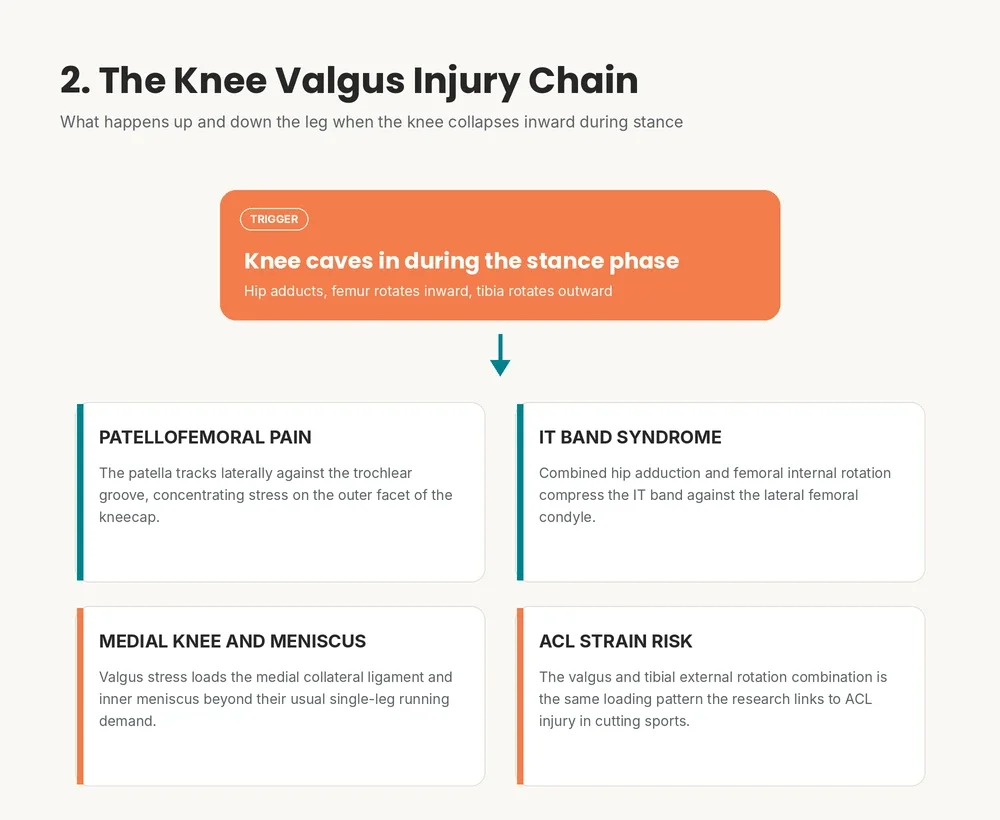
When the knee caves in on each stride, four main structures take the extra load.
Patellofemoral pain is the most common consequence. The patella tracks laterally in its groove rather than centrally, concentrating compressive stress on the outer facet. Runners often feel this as diffuse pain around or behind the kneecap that gets worse with downhill running, prolonged sitting, or stair descent.
IT band syndrome follows the combined hip adduction and femoral internal rotation that drive the valgus. The IT band compresses against the lateral femoral condyle, which shows up as sharp lateral knee pain that comes on at a predictable distance into each run.
Medial knee and meniscus stress builds because valgus angulation opens the inner knee joint and closes the outer one. The medial collateral ligament and the inner meniscus absorb more tension than their single-leg running role normally requires, which can show up as a dull inner-knee ache that worsens with mileage.
Tibial and ACL strain rises with the degree of valgus. Even when the ACL doesn't fail acutely, chronic exposure to that loading pattern increases the risk of tibial stress injuries, especially when a runner has weak hip control, a fresh training load, and new terrain demands all stacking at once.
How Gait Analysis Catches Knee Valgus
A running-focused evaluation captures knee valgus from a front-view camera recording slow-motion video at the runner's typical training paces. Markers or visual landmarks on the hip, knee, and ankle let the clinician measure the angle between them at footstrike, mid-stance, and toe-off. The measurement gets paired with hip strength testing, ankle mobility screens, and the runner's injury history so the recommendations target the actual driver rather than the symptom. This is the core of what a gait analysis shows for runners whose knee pain has resisted other treatments.
What the Measurements Actually Tell You
Research references a frontal-plane knee projection angle under about eight degrees as clinically normal during single-leg stance, with higher values associated with more injury risk. The number alone isn't enough, though. A runner whose valgus angle increases dramatically between mile one and mile six has a fatigue-driven pattern, which responds differently than a steady-state valgus that appears on the first stride.
Asymmetry carries important information. A runner whose right knee caves in while the left stays neutral almost always has a right-side hip stability deficit, because the right stance phase is where the breakdown happens. Treating only the painful knee usually misses this. The same principle applies when valgus shows up alongside other front-view findings during a running gait analysis, including hip drop, trunk sway, and foot pronation patterns that cluster together in the same stride.
The evaluation also distinguishes between knee valgus that responds to strength work and knee valgus that needs movement retraining first. A runner who can hit a clean single-leg squat in the exercise room but still shows valgus running on the treadmill has a motor control problem, not a strength problem, and the plan shifts accordingly.
How Knee Valgus Relates to Other Gait Faults
Knee valgus rarely shows up alone. The same hip stability deficit that drives the knee inward also drives several other patterns that often appear in the same stride.
Contralateral pelvic drop sits directly upstream. When the glute med can't hold the pelvis level during single-leg stance, the hip adducts and the femur with it, and the knee follows inward. Fixing one usually helps the other, which is why a comprehensive plan treats them together.
A crossover gait commonly shows up alongside knee valgus too. When each foot lands across the body's midline, the knee has already drifted inward relative to the hip before footstrike happens, and the valgus angle at mid-stance is magnified. Runners who present with knee valgus as their main complaint often turn out to have a step-width problem driving it.
Excessive foot pronation closes the chain from below. The tibia rotating inward after footstrike pulls the knee medially, so a runner with knee valgus and heavy pronation needs both the hip and the foot addressed rather than just one. A running-focused evaluation checks both ends to avoid treating only the louder symptom.
Fixing Knees That Cave In Without Overcomplicating It
The two interventions that consistently produce lasting change are hip strengthening and movement retraining, in that order. Strength work alone often fails because the runner builds the capacity but never learns to use it during the specific demand of running. Retraining alone often fails because the runner can't hold the new pattern under fatigue without the strength to back it up.
Phase 1 - Build the Hip Capacity
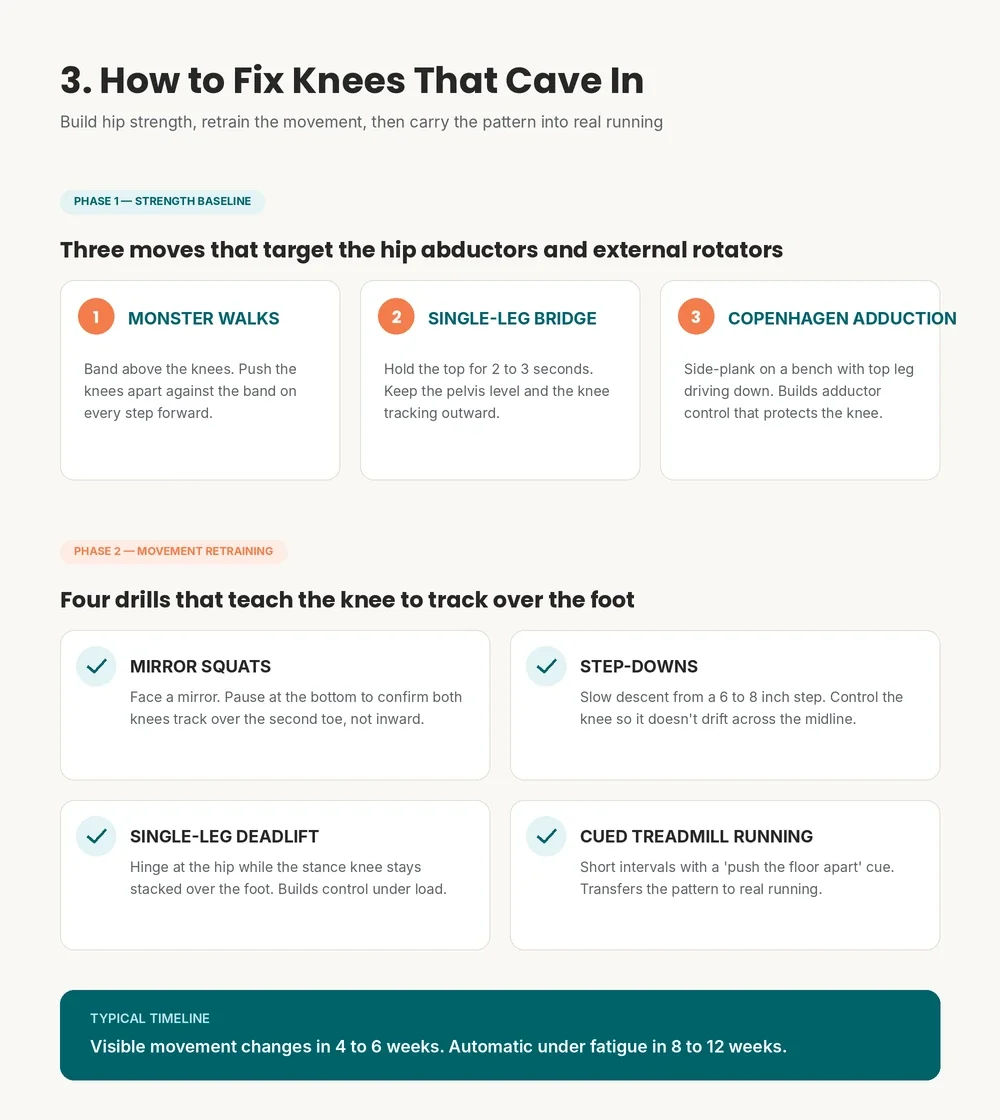
The hip abductors and external rotators need enough force and endurance to hold the femur against the body's weight across thousands of strides. Four exercises cover most of what runners need.
Side-lying hip abduction with the top leg slightly behind the body hits the glute med in a position close to its running role. Single-leg bridges build posterior hip endurance under load, which carries into the push-off phase of running. Monster walks with a band above the knees train the hip abductors in an upright position, pushing against external resistance in the same plane the valgus collapses through. Copenhagen adductions build the opposite muscle group, which matters because weak hip adductor control also contributes to knee instability.
Progression beats variety here. Running the same four exercises for eight to twelve weeks with gradually increased load, hold times, or repetitions builds the tissue adaptations that let the hip hold the knee under running demands. Running physical therapy at The Runner's Mechanic pairs this strength plan with specific dosing based on how the runner tested in the initial evaluation, so the load scales to the deficit rather than to a generic protocol.
Phase 2 - Retrain the Movement
Strength without motor control doesn't transfer. The runner has to learn to use the new capacity in positions that look like running.
Mirror squats let the runner watch their own knees track and correct the valgus visually in real time. Step-downs from a six-to-eight-inch box isolate single-leg deceleration, which is the specific demand that produces valgus in running. Single-leg deadlifts teach the runner to hinge at the hip while keeping the knee stacked over the foot. Cued treadmill running with a verbal cue like "push the floor apart" starts transferring the new pattern to actual running, with real-time video feedback during the session making the correction visible rather than imagined.
Phase 3 - Lock the Pattern In
Once the valgus angle starts coming down in the clinic, the pattern has to hold under fatigue in training runs. Keeping the hip strengthening at two to three sessions a week through the training block maintains the capacity. Occasional cueing on easier runs keeps the motor pattern fresh. A follow-up evaluation at six to twelve weeks confirms the change held up under running conditions rather than only inside the exercise room.
When Knees Caving In Might Not Be the Real Problem
Not every runner with a visible knee valgus needs to change it, and not every knee pain that looks like a valgus problem actually is one. Some runners run comfortably for years with a small amount of frontal-plane knee motion, particularly if their hip and core strength are strong enough to control the surrounding structures.
A knee valgus that only appears in the last mile of a long run usually signals fatigue in the hip abductors rather than a structural problem, which means the plan prioritizes endurance over peak strength. A one-sided valgus often reflects a leg-length or ankle-mobility asymmetry that needs its own assessment. Knee valgus that resolves when the runner widens their step width is really a step-width problem, not a knee problem, and the intervention changes accordingly.
That's why an evaluation that looks at the full chain, from foot mechanics through hip strength to trunk control, gives better answers than any single camera angle. The knee valgus measurement tells you the symptom. The rest of the evaluation tells you what to actually work on.

Run pain-free, run longer
Frame-by-frame gait analysis, hands-on treatment, and a plan built around the mechanics of your stride, all in one Asheville visit.
Frequently Asked Questions
How do I know if my knees cave in when I run?
Have someone record you running on a treadmill or outdoor flat surface from directly in front at eye level. Play it back in slow motion and watch the stance phase on each leg. If the knee drifts inward past the second toe or past a vertical line from the hip, you have some degree of knee valgus.
Does knee valgus always cause pain?
No. Plenty of runners log high mileage with mild knee valgus and no symptoms because their surrounding structures can tolerate the load. The pattern matters most when it shows up alongside pain, a recent training-load jump, or a recurring knee injury.
How quickly can I fix knees that cave in?
Visible improvements in single-leg squats and step-downs usually show up in four to six weeks of consistent work. The pattern holding automatically during running usually takes eight to twelve weeks because motor control takes longer to transfer than isolated strength.
Will new shoes fix my knee valgus?
Shoes can change how the foot pronates after landing, which affects the tibia's rotation, but they can't change what the hip and femur are doing above the knee. A runner whose valgus is driven mostly by hip weakness won't see lasting change from a shoe switch. A runner whose valgus is driven by excessive pronation might get partial improvement from the right shoe, but the hip work still matters.
Is knee valgus the same as being knock-kneed?
They're related but different. Static knock-knees describes the resting alignment of the legs, measured standing still. Dynamic knee valgus describes how the knee moves during loading, measured during activity. A runner can be dynamic valgus without being static knock-kneed, and a knock-kneed runner can keep a neutral dynamic angle with good hip control.
Should I stop running if my knees cave in?
Usually not. Unless the valgus is driving acute pain or an injury that needs rest, most runners can keep training while addressing the underlying strength and movement issues. Adjusting mileage, downhill exposure, or cumulative single-leg load can reduce the stress on the knee while the capacity comes back.
Can I fix knee valgus at home?
Many runners can make meaningful progress with a self-directed hip strengthening program plus video check-ins on their own form. A clinical evaluation becomes more useful when the pattern has resisted self-treatment, the pain has become limiting, or the runner wants precise measurements to track against.
Does cadence matter for knee valgus?
Yes, indirectly. A higher cadence shortens the time each foot spends on the ground, which reduces the window the knee has to collapse inward. Research has linked cadences in the 170-to-180 steps-per-minute range to cleaner running mechanics, and a small cadence adjustment is one of the simpler cues that can reduce a mild valgus pattern.
TL;DR
Knees caving in when running, clinically known as dynamic knee valgus, means the knee drifts toward the midline during the stance phase instead of stacking cleanly over the foot. The pattern is driven from above (weak hip abductors and external rotators), from below (foot pronation and ankle restriction), or from the middle (trunk and core instability). Research consistently links knee valgus to patellofemoral pain, IT band syndrome, and higher strain on the medial knee structures. Fixing it takes a combination of hip strengthening and movement retraining, with visible change usually appearing in four to six weeks and lasting change in eight to twelve. Treating the knee alone rarely works because the knee is where the pattern shows up, not where it starts.
Whether you've been chasing patellofemoral pain, dealing with a lateral knee flare at a predictable mileage, or watched your form unravel in the back half of long runs, a running-focused evaluation at The Runner's Mechanic puts knee valgus in context with everything else your stride is doing. Miriam Salloum uses front-view video analysis, hip and core testing, and hands-on treatment to build a plan around your specific mechanics. Book your evaluation or call 828-713-0929 to get started.